The short answer
Define the material and meaning unit, write usable code boundaries and keep observations separate from interpretation. Review overlapping codes, ambiguous passages and counterexamples before summarizing. A tidy coding table does not establish representative opinion, independent agreement or a causal content effect.
What you’ll take away
- Declare the source scope and unit before assigning codes.
- Allow overlap and unresolved interpretation; preserve contrary cases.
- Count units and assignments separately, with their actual limitations.
Choose legitimate material and an explicit unit
Use notes or open responses you may legitimately analyze for the stated purpose. Record collection scope, source version and missing context. A meaning unit can be a bounded passage expressing one relevant idea; it is not automatically a person, whole response or independent observation. Keep enough context to understand it without copying names, private messages or unrelated personal details into a public worksheet.
GOV.UK distinguishes captured observations, grouped material, findings and actions in research analysis. Our descriptive codebook is an original practical adaptation, not a universal thematic-analysis procedure. We deliberately retain contrary and unresolved material rather than discard it merely for being isolated. No actual participant notes or independent coders produced the example below.
Write inclusion and exclusion boundaries
Constructed codebook v1: P applies to an explicit question about the reporting period; D to a question about the counted unit or denominator; A to an explicit problem opening or reaching the material. For each code, include its definition, an example and a non-example. “It does not work” is not automatically A because the missing context might concern a calculation rather than access.
Permit more than one code when the unit genuinely contains multiple relevant ideas. Preserve the original passage and why each code applies. Keep ambiguous, irrelevant and contrary material in distinct states instead of forcing it into a convenient theme. A code label summarizes an interpretation; it does not turn a reported problem into a reproduced product defect.
Inspect all eight constructed units
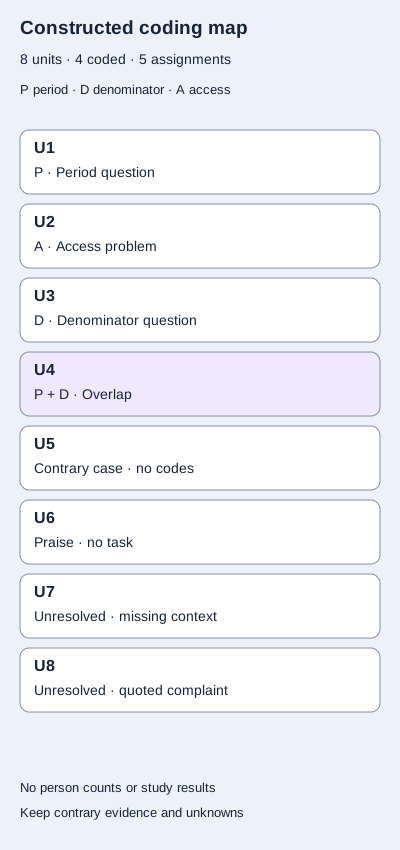
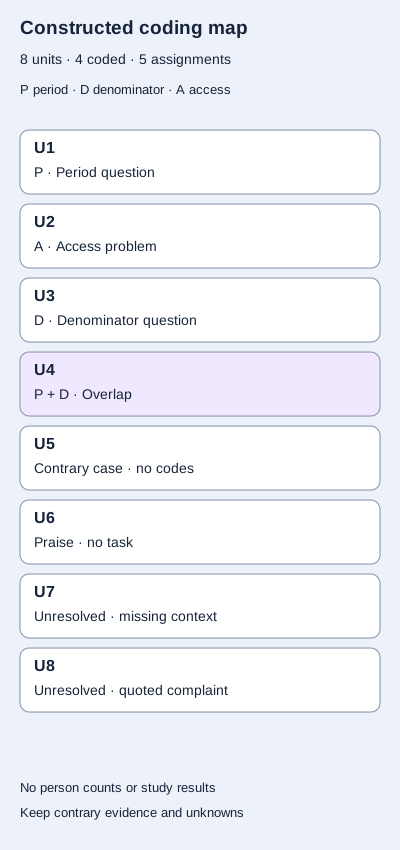
U1 asks “Which dates?” and receives P. U2 says “The file will not open” and receives A. U3 asks “What is the denominator?” and receives D. U4 asks “Which dates and which denominator?” and receives P plus D. U5 says the source was clear and is retained as a contrary case. U6 is praise without a task. U7 says “It does not work” without context; U8 quotes another person’s unclear complaint. U7/U8 remain unresolved, with no access code assumed.
There are eight supplied units, four coded units and five code assignments: P twice, D twice and A once. Those totals overlap at U4. They are neither eight people nor five independently confirmed problems. A bounded interpretation is that the constructed set illustrates period, denominator and access questions with a contrary case and unresolved context. It does not establish their frequency among real readers.
| Unit | Codes | Declared state |
|---|---|---|
| U1 | P | period question |
| U2 | A | access problem |
| U3 | D | denominator question |
| U4 | P + D | overlap |
| U5 | — | contrary case |
| U6 | — | praise, no task |
| U7 | — | unresolved |
| U8 | — | unresolved quotation |
Resolve three coding mistakes
C1 — Constructed overinterpretation: a first editorial pass assigns A to U7 because the phrase sounds negative. Decision: remove that unsupported assignment and retain unresolved context in the revision log. Outcome: a changed interpretation, not proof that two independent coders agreed.
C2 — Constructed double count: a summary adds P2, D2 and A1 and calls them five people. Decision: report five overlapping assignments across four coded units, with eight units supplied. Outcome: the counting unit survives; unique people and population prevalence remain unknown.
C3 — Constructed selective theme: a summary removes U5 because it challenges the proposed “everyone is confused” story. Decision: retain the contrary case and narrow the interpretation. Outcome: a more inspectable account without invented consensus or a validated product diagnosis.
Review disagreements and version the interpretation
Compare the actual unit, code boundary and reason behind a disagreement. Revise the codebook or leave the passage unresolved when context is missing. Revisit earlier assignments affected by a definition change. If several real reviewers participate, retain their actual independent or collaborative roles; do not call two passes by one editor independent agreement.
Agreement is not truth, and a percentage cannot repair an unclear unit definition. Different qualitative approaches treat coding and agreement differently; this practical descriptive exercise does not certify one universal method or supply a meaningful reliability coefficient. Keep observation, interpretation, proposed content action and later actual reader outcome in separate fields.
Keep the codebook, ledger and unresolved material
The packet includes the full eight-unit ledger, definitions and non-examples, revision decision, bounded interpretation and a blank private coding record. The original map shows U4’s overlap and U5/U7/U8 states. The offline checker verifies declared counts and memberships only; it cannot classify new prose, reconstruct context, identify people or establish representative findings.
Primary analysis guidance was read on 1 November 2026. Every unit and assignment is constructed. No interview, feedback collection, real coding team, independent review, study or customer result occurred. Use the reader-question guide when the narrower job is choosing a follow-up topic; use this workflow when a traceable interpretation of qualitative material is needed.
- Bound the legitimate material and meaning unit.
- Define each code with inclusion and exclusion examples.
- Code complete units while retaining overlap and unknown context.
- Review disagreements, counterexamples and changed definitions.
- Report units, assignments and limited interpretation separately.
Sources & product references
Product details reflect the publication date. External features and interfaces may change.