
The short answer
Agree the receiving authority and exact Page, deliver the editable work and unresolved actions, then verify that the incoming authorized person can perform the intended task. Keep a responsible super admin in place. Address queued work and remove only the intended outgoing access after the handoff conditions are met. A file sent, role assigned and responsibility accepted need separate evidence.
What you’ll take away
- Hand over a Page responsibility through roles; do not transfer a personal login.
- A correct file bundle does not prove that incoming access or acceptance works.
- Retain the client’s admin control and give every pending publication a responsible owner.
Define the continuing responsibility and its recipient
List the exact organization Page, incoming publishing responsibility, authorized client decision-maker and proposed handoff time. Distinguish a personal profile, company Page, Showcase Page and external publishing service. This guide concerns continuity of a Page task, not a legal ownership transfer, account sale or permission to share someone’s credentials.
Name the continuing work: source maintenance, draft review, scheduled items, corrections and necessary reporting. A proposal describes what should be delivered; an analytics-only access request establishes a narrower task. A handoff closes the continuity question: who can carry on with these exact files and outstanding actions after the outgoing person leaves?
Check incoming capability while client control remains available
LinkedIn separates Super admin, Content admin and Analyst. Its permission matrix distinguishes admin management from posting and analytics. Choose the role needed for the actual continuing task; access to analytics alone does not establish publishing capability. The documented add-admin workflow requires a super admin and has member eligibility conditions. Use the intended identity rather than a similarly named substitute.
Record the saved role and an appropriate authorized incoming task check, such as opening the intended Page’s draft workflow without publishing. Do not perform a public test post merely to prove the handoff. LinkedIn requires at least one super admin, and a sole super admin must appoint another before removing themselves. Parent-Page access also does not automatically cover affiliated Showcase Pages.
Deliver usable source work, not only final exports
The original handoff example contains an editable content master, source register and pending-action table. Its manifest identifies the exact file versions and byte fingerprints. The receiving person needs appropriate access and enough context to use them: permitted source, period, definitions, unresolved claims, language versions and any essential dependencies. An attractive PDF alone may not let anyone correct its source.
The supplied checker reads the actual three local files and compares them with the manifest. It also detects a deliberately changed content-master copy. That proves a bounded file-identity check, not source truth, rights, successful receipt or client acceptance. For real work, have the authorized recipient open the intended files and record their actual review; a download receipt cannot replace that check.
| Handoff component | Check needed | Keep separate |
|---|---|---|
| Incoming task | Correct Page, role and usable workflow | Invitation or saved role alone |
| Editable files | Exact versions open for the intended recipient | Filename or sent-link receipt |
| Pending publications | Each item has a deliberate destination and owner | Assumed cancellation after role removal |
| Outgoing access | Intended removal or change observed afterward | Vendor-held data and billing |
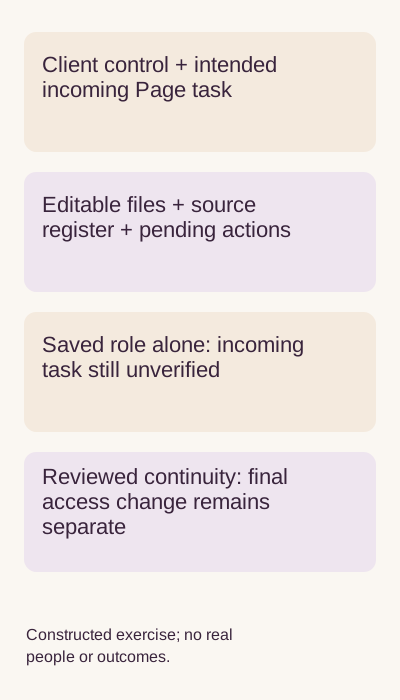
Resolve three incomplete handoffs before access removal
H1 — The fictional bundle matches its manifest and the incoming role is saved, but no incoming task check is recorded. Decision: keep the handoff pending and retain an authorized route for continuity. Result: files identified and role assigned; usability and acceptance remain unverified. Do not remove the outgoing role solely because a link was sent.
H2 — Incoming use is recorded in the teaching ledger, but one queued post has no agreed owner or destination. Decision: hold completion while the authorized parties decide whether it stays, moves or is cancelled, and inspect that actual state. Result: an open publication responsibility, not an automatically cancelled queue.
H3 — The supplied fictional ledger records incoming use, reviewed exact files, client admin continuity and assigned queue responsibility. Decision: proceed to the intended final access change. Result: ready for outgoing-access review. Until that change is actually observed, the fixture does not label access revoked or the overall handoff completed.
Close the intended access and leave other systems explicit
After the authorized transfer conditions are met, the responsible super admin uses the correct Page’s admin controls for the intended outgoing role change and reopens the saved state. Read the confirmation and preserve necessary minimal evidence. Do not remove unrelated administrators, revoke a client’s only control path or alter an external service just to make a checklist shorter.
Native role removal does not establish that a connected service stopped publishing, deleted prior data or ended billing. Track those components in their responsible systems with the separate exit guide. Similarly, an agreed correction contact is a maintenance responsibility, not a promise that everyone who downloaded an earlier report will receive an update.
Finish with a recipient-specific continuity receipt
Use the private record for Page identity, actual authority, incoming task evidence, editable files, queue decisions, source and correction ownership, outgoing-role result and unresolved service actions. Keep real member references and private material out of a public template. Requested, delivered, usable, accepted and access removed are separate states, and an unknown stays open.
Primary role/add/remove help was read separately in English and German on 1 November 2026. All H-cases and role tokens are constructed. No client, member, Page role, file permission, queue or subscription was changed. The local file check and decision exercise are not an actual handoff, independent audit, reader outcome or payment evidence.
- Agree exact responsibility and authorized recipient.
- Keep client admin control and verify incoming task access.
- Deliver and inspect exact editable work and source notes.
- Assign each pending publication and correction.
- Verify the intended outgoing-access change and leave other systems explicit.
Sources & product references
Product details reflect the publication date. External features and interfaces may change.
- LinkedIn: Page role permissions, English
- LinkedIn: Seitenberechtigungen, Deutsch
- LinkedIn: add Page admins, English
- LinkedIn: Seitenadmins hinzufügen, Deutsch
- LinkedIn: remove a Page admin, English
- LinkedIn: Seitenadmin entfernen, Deutsch
- Original team, handoff and learning exercises with editable records


