
The short answer
Start with the decision the answers could inform. Ask one specific question, offer distinct relevant choices and review the draft in LinkedIn before publishing. A public opt-in poll describes its votes; it does not establish what all followers, customers or potential buyers think.
What you’ll take away
- Choose the question before choosing the desired result.
- The local planner checks lengths and duplicates, not neutrality or representativeness.
- Poll authors can see individual votes; avoid sensitive questions.
Write down the decision first
Suppose you are preparing a practical session about reviewing a draft. You need to decide which obstacle to address first. That is a narrower job than proving that your product is popular. Write the audience, the decision and what you would do with each plausible answer before drafting the question.
A poll is a poor fit when someone needs several paragraphs to explain their situation, the subject is sensitive or your choice depends on people who will not see the post. Use a conversation or a more suitable research method when a short single-choice question cannot preserve the distinction that matters.
Make the choices answer the same question
Pew’s questionnaire guidance recommends specific wording, one concept at a time, and non-overlapping response choices. Apply those principles to the actual decision. An attractive question with choices that mean different things still produces an ambiguous result.
For an explicitly fictional example, ask what most slowed down the respondent’s last draft review. The choices below concern the same recent task. They are a starting point to pretest, not a validated questionnaire. Check whether the intended reader can choose one answer and whether a missing case needs an explicit alternative.
| Draft element | Example or revision |
|---|---|
| Question | What most slowed down your last draft review? |
| Choices | Missing information; time to review; unclear ownership; other / not applicable |
| Ambiguous alternative | Do you like faster, better reviews? mixes speed, quality and approval |
| Pretest | Ask a willing reviewer what they think each choice means before using the poll |
Check the current interface and length limits
LinkedIn’s FAQ lists 140 characters for the question and 30 per choice. It currently distinguishes up to four options on desktop/Android from up to five on iOS; the API documents two to four. Our planner uses the portable two-to-four option range and does not publish through that API.
Write a draft, choose its duration and inspect the final composer before posting. The planner checks technical string units conservatively; emoji can make counters disagree. It cannot confirm platform acceptance. Keep the question and options in a private text file so a last-minute edit does not erase your intended wording.
Make participation expectations clear
The poll author can see how individuals voted, and Page administrators can see votes on their Page’s poll. Do not describe it as anonymous. Explain the purpose without asking for health, personnel or other sensitive disclosures. An optional comment can expose even more context, so do not pressure people to explain a vote publicly.
Check the intended audience and exact wording before publishing: LinkedIn says a created poll cannot be edited and a closed poll cannot be reopened. The duration is part of your plan, not a way to extend only an inconvenient result. A poll draft or successful upload is not evidence that the final public version is correct.
Report votes with their actual denominator
In a fictional result, six of twenty votes choose missing information: 30% of those votes, not 30% of all followers. Some eligible people never saw the post; others saw it and did not answer. Topic, distribution, wording and who chose to respond can all affect the observed mix.
Record the question, choices, duration, audience setting, vote count and closing observation. Preserve other/not-applicable responses. Use a small result to decide what to investigate next and state its selection limits. It does not establish market demand, purchasing intent or a causal effect of the format.
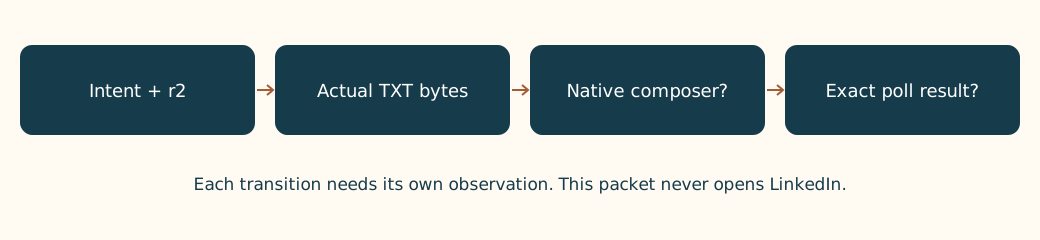
Carry one reviewed draft through the actual text export
The original local exercise below keeps the decision, current wording r2, actual text files and supplied later observations separate. Its current question and four choices are the fictional example above. The English question has 45 technical string units and the German one 50; their longest choices have 22 and 25. Both plan seven days. Those counts describe these files, not a native boundary or a validated questionnaire.
Four real TXT files contain current r2 and older r1 wording in both languages. Their exact contents match the unchanged planner’s text construction when its actual preparation helper runs. The stale file is readable and formally valid, yet it asks a different question. Compare the chosen bytes with the reviewed revision before using them; a familiar filename or a successful local preparation cannot establish the final composer or published poll.
A second supplied variant offers “Not enough time” and “Insufficient time”. Both pass the formal length and normalized-duplicate check. The exercise declares their shared meaning as a teaching observation, not a real reader pretest or a general semantic detector. Keep that meaning review and any changed wording open until they have appropriate evidence. A technically valid draft can still ask the wrong question.
- Keep the decision, intended audience and exact question/options revision together.
- Review meaning and missing alternatives; the formal checker does not do this.
- Open the actual local TXT and compare its contents with that revision.
- Inspect the intended member or Page, offered authority, audience and final native composer separately.
- After a deliberate creation, verify the exact poll; keep an unobserved result unresolved.
Resolve ten planning, publication and result records
L1 has matching current local files: it is prepared locally, while real pretesting, the native composer and publication remain unobserved. L2 supplies the overlapping-choice variant rather than the current reviewed wording and is held. L3 chooses the actual older r1 files and is held for stale bytes. These are planning safeguards, not observed platform rejections.
L4 supplies another member’s composer. L5 substitutes a Page content role for the native FAQ’s super-admin creation scope. L6 requires anonymity although authors can see individual votes. All three are held. API organization permissions and a Group author’s result access do not silently change native Page authority or make a poll anonymous.
L7 supplies Create as submitted without a later exact poll: publication is unobserved. L8 tries to use follower stock as the response denominator and is held. L9 supplies the exact closed T1/r2 aggregate below. L10 supplies another poll and is held. These fictional inputs neither create a poll nor collect, identify or contact voters.
In L9, INFO is six of twenty supplied votes, or 30%; TIME is seven, or 35%. The other two choices remain in the denominator. This is not a claim about everyone who saw the poll, all followers or buying intent. A closing state and timestamp belong with the result; unknown exposure and nonresponse do not become zero or a representative sample.
| Declared choice in r2 | Supplied votes | Share of these 20 votes |
|---|---|---|
| INFO — Missing information | 6 | 30% |
| TIME — time to review | 7 | 35% |
| OWNER — unclear ownership | 4 | 20% |
| OTHER — other / not applicable | 3 | 15% |
Rebuild the files and keep a private completion record
The packet supplies ten actual CSV plans, independent facts and supplied observations, four aggregate count rows, four local TXT exports, complete bilingual decisions and private blank records. With existing Python 3, extract it and run python3 check.py. To rebuild into another empty folder, run python3 build.py --out /path/to/empty-folder. No installation or network is required. The extracted rebuild reproduces all 22 files, including its ZIP, byte for byte in the recorded runtime.
The checks reject missing or duplicate records, changed count sources, mixed or naive timestamps, wrong selected locale, undeclared files and unsupported outcomes. Wrong publisher, stale text, native-role/privacy mismatches and the wrong result object remain explicit holds. Known file and declared-input checks cannot authenticate a person, infer arbitrary question meaning or certify a native save, publication, delivery or market result.
Use the blank privately for the source revision, actual file, observed composer, submitted operation, exact poll and result denominator. No voter names are needed for this exercise. Current complete primary bodies were checked in English and German on 2 November 2026. No private account, native poll, pretest participant, vote, message, recipient or device was used. The original guide and cover remain; this adds no new topic, formal study, aid type or real reader/customer evidence.
Sources & product references
Product details reflect the publication date. External features and interfaces may change.


