
The short answer
Record the post, metric, observation date, scope and source while you can actually access them. Analytics categories have different windows, and current official pages disagree on video retention. Plan preservation early, inspect your own access and retain the disagreement; neither a help-page deadline nor a saved total guarantees future availability.
What you’ll take away
- A visible engagement total does not imply old demographics or video metrics remain available.
- An inaccessible metric is unknown, not zero and not necessarily deleted.
- Preservation is a private source record, not permission to publish another person’s data.
List evidence by metric rather than by account
Before an annual recap, list the specific claims you may need to support: impressions at a stated age, reactions/comments, members reached, video watch metrics or audience demographics. Link each to its original post and observation date. A current all-time profile panel is not a substitute for a missing post-specific snapshot.
For a real post you own, use its actual analytics access and save only the information required for your purpose in an authorized private location. Record content type, selected date range, whether the count is cumulative, unit, value or unavailable state, and the source check date. The worksheet is not an automatic export or a backup of LinkedIn’s underlying records.
Keep the conflicting policy evidence visible
At this review, LinkedIn’s analytics definitions page lists 365 days for video performance and video demographics. Its analytics-access page lists 180 days for those categories. Both are official sources; selecting the larger number and calling it guaranteed would hide an unresolved conflict. Use earlier preservation as a planning precaution, but do not claim even the shorter window guarantees access.
The pages agree on two years for article/newsletter categories and, for other content types, different windows for discovery/social counts, members reached and demographics. These are category-specific guidance, not a universal retention clock for every item or an assurance after deletion/account changes. Keep the source date with your plan because product guidance can change.
| Category | Current documented guidance | Planning implication |
|---|---|---|
| Video performance/demographics | 365 versus 180 days across the two sources | Unresolved conflict; preserve needed evidence early |
| Article/newsletter categories | Two years | Keep the exact metric/type and source date |
| Other-content discovery/social; reached; demographics | 1,000; 400; 180 days respectively | One available category does not restore another |
Make a reusable private snapshot
A complete snapshot says which original post was inspected, its publication timestamp if known, the observation timestamp/timezone, metric label/unit, selected scope and actual observed value. Save the original source representation when authorized and useful, not only a number copied into a chart. Preserve how an unavailable field appeared without turning it into zero.
Use a dated filename or private record identifier and keep later observations as new versions. A screenshot with an unreadable filter or missing capture date is weak evidence. Review names, access permissions and expiry for the stored file too. Saving evidence for personal analysis does not authorize public disclosure of identifiable people or confidential business context.
Decide what the available evidence can support
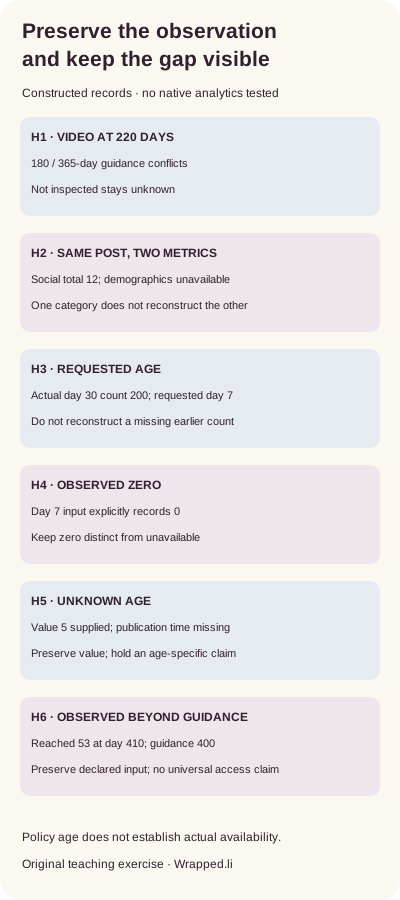
H1 — A fictional video is 220 days old and no watch metric has been inspected. One source’s 180-day guidance would place it beyond that window; the other’s365-day guidance would not. Decision: mark current availability unknown, inspect only the owner’s actual analytics if appropriate, and preserve any genuinely available result with its date. Neither source conflict proves loss or proves successful recovery.
H2 — A fictional non-video post at age 220 days still shows a recorded reaction total, but demographics are unavailable. The categories have different documented windows, so the visible total does not reconstruct the missing demographic breakdown. Safe recap wording describes the saved total and says the demographic field was unavailable at capture. It does not say the audience had zero members in a country.
H3 — A fictional January recap needs impressions at seven days, but the only saved snapshot was captured at day 30. Both may be valid observations of different ages. Decision: use the stated day 30 value or hold the seven-day claim; do not relabel the file, interpolate a historical count or imply an export recovered an observation never saved. A preservation plan improves future evidence, not the past.
Review the preservation plan before the annual cutoff
Prioritize expiring evidence that a specific decision genuinely needs. Add a review date and responsible person, then verify saved files actually open with their context intact. An intended reminder or export is not a completed snapshot. No reminders, account connections, private-data exports or recovery jobs are created by these downloads.
Keep the conflict record and use the links to recheck guidance when preparing the real plan. If a field remains unavailable, narrow the claim instead of buying an unverified promise to reconstruct private analytics from public reactions. The goal is a defensible recap evidence trail, not an assertion that every past metric can be recovered.
Execute the preservation decisions on seven actual input rows
The new constructed CSV makes H1–H3 explicit and adds three boundary cases. H1 has 220 days between publication and the record time, but its watch metric was not inspected. That age falls between the two documented video numbers, 180 and 365. The result retains an empty value and unknown availability. A time comparison is not an observation of native access.
H2 has two rows for the same fictional post at 220 days: a supplied reaction total of 12 and unavailable demographics. The total stays 12; the missing breakdown stays unavailable with an unknown reason. H3 supplies 200 impressions at day 30 when the requested claim needs day 7. Preserve the day-30 snapshot and hold the earlier claim. Neither an available category nor a later count reconstructs the missing observation.
H4 explicitly supplies an observed zero at day 7 and keeps it zero. H5 supplies a value of five but no publication timestamp, so the snapshot value remains while an age-specific claim stays unverified. H6 supplies 53 members reached at day 410, beyond the help’s 400-day number. Keep that declared input and its scope instead of forcing it into missing. This fictional row neither demonstrates native access at that age nor refutes the source guidance.
| Constructed input | Preserve | Keep separate |
|---|---|---|
| H1: video, age 220, not inspected | Empty value and not-inspected state | 180/365-day source conflict |
| H2: reactions 12, demographics unavailable | Each metric’s own observation | No reconstructed audience breakdown |
| H3: 200 impressions at day 30 | The actual declared snapshot age | Requested day 7 remains unobserved |
| H4 / H5 / H6 | Zero / value with unknown age / later supplied value | Missing / invented publication date / universal access claim |
All seven rows are constructed teaching inputs. No account, analytics panel, reader or customer was observed.
Check the record without turning guidance into a guarantee
Extract the packet and run python3 check.py with Python 3 already available. It verifies actual file identities and recomputes timestamp differences, requested-age mismatch, observation state and value. The supplied checker rejects duplicate records, an unobserved field carrying a count, timestamps without an explicit zone and a record time before publication. It does not create reminders, exports or recovery jobs.
The calculation labels an age’s position relative to the documented day counts; it does not infer access, expiry or a reason for missing data. It leaves an exact day-count boundary unspecified and does not convert the separate two-year article/newsletter guidance into 730 days. The complete bilingual decisions and blank record keep source versions, actual metric scope, observation state, requested age and saved-file review together. The sources were rechecked on 2 November 2026 in Europe/Berlin; their conflicting video guidance remains explicit.
Sources & product references
Product details reflect the publication date. External features and interfaces may change.
- LinkedIn Help: Post analytics definitions and availability
- LinkedIn Help: Access post analytics and availability
- LinkedIn: post analytics definitions and availability (English)
- LinkedIn: post analytics definitions and availability (Deutsch)
- LinkedIn: view post analytics and availability (English)
- LinkedIn: view post analytics and availability (Deutsch)
- Original constructed preservation inputs and complete bilingual records


