
The short answer
Open the intended article in the desktop publishing tool, confirm the author/Page and draft, then use its Preview and Share draft workflow only for an intentional review. LinkedIn describes the preview as public while also requiring members to be signed in to view it. That is not selected-reviewer-only access. A Duplicate as draft result is a separate draft to inspect, and a checked preview does not establish publication or inherit another version’s review.
What you’ll take away
- Identify the native draft and publisher, even when two titles match.
- Keep public-preview wording and the sign-in requirement together.
- A new branch needs its own current-content check before publication.
Define the review question and the draft that answers it
A useful review request names a decision: for example, whether the example supports “12 of 20 checks completed” and whether the remaining eight are explained. Record the intended draft, publishing identity and source version before choosing a link. A screenshot of a title cannot identify the correct branch when an original and duplicate share that title.
This task completes native article-draft review. The existing post-draft guide handles saving and resuming a feed composer; the format guide chooses article versus newsletter; the maintenance guide updates a published body. The approval guide explains a separate service’s permissions. None of those states turns a native article preview into a technical publication lock or evidence of a real reviewer’s agreement.
Choose the actual draft and understand its preview access
The desktop draft help uses the publishing tool’s Manage and Drafts views. It describes automatic article-draft saving and reopening a saved item. From the current or reopened article, Preview offers Share draft and a copied link; the native workflow is not available in the LinkedIn mobile app. Check the actual current item instead of sharing a convenient older tab.
The same help calls the preview public and separately states that members need to be logged in to view it. Preserve both conditions. A sign-in prompt alone does not establish that a link is private, limited to named reviewers or suitable for confidential material. If the intended review needs a genuinely restricted channel, choose an authorized channel that meets that need before distributing content.
A copied link is a prepared reference, not evidence that it was sent, opened, read or approved. This guide generates no native link and contacts no one. Keep sensitive source details out of a broad preview; deleting a local note later does not prove that a previously shared copy disappeared.
Treat a duplicate as another draft to inspect
The documented Duplicate as draft action opens a draft copy on a new page. Identify that new item and reopen its current text before adapting it. The source does not establish automatic synchronization between branches or inherited approval. A matching title or a familiar preview address is weaker than an inspected draft identity and current contents.
Our supplied original A says 12 of 20 checks; branch B says 15 of 20. Both language versions are explicit local teaching texts. A review reference to A cannot certify B’s changed count. Keep the original and copied-from relationship, current body and actual preview observation together. This is a declared editorial comparison of local records, not a capture of native duplication behavior.
Confirm who the draft represents before any later publication
The draft help includes a Publish as choice for Page super/content admins. The Page publishing guide also distinguishes writing as the Page or as yourself and selecting an individual article versus a newsletter edition. Read the actual publisher and destination with the draft. Access to an organization’s content is not evidence that your personal byline is the intended public author.
Keep review access separate from publishing authority and the eventual Publish or scheduling action. An analyst can inspect a permitted draft without becoming the authorized publisher. A returned comment or an attractive preview cannot show that the right Page, edition, text or time was ultimately used. No publishing, scheduling, invitation or role operation is performed by the worksheet.
Resolve six complete constructed draft reviews
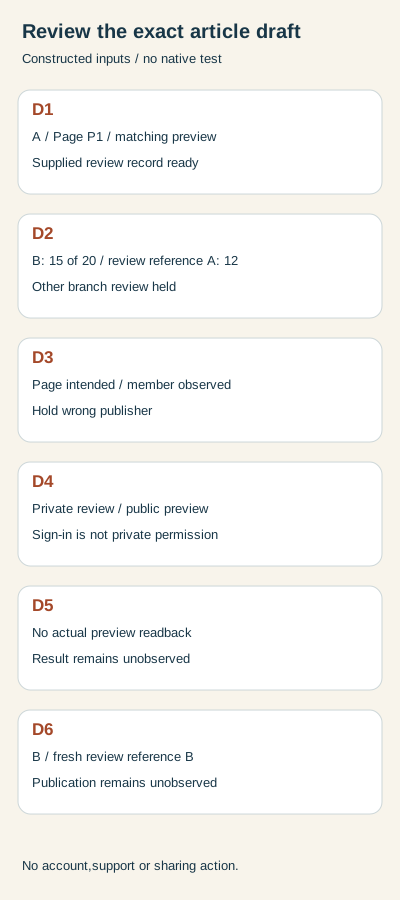
D1 supplies original A, the expected Page identity, matching English/German body references and a supplied matching preview observation. Decision: the local record is ready for its bounded review purpose; nothing has been shared or published. D2 supplies branch B with 15 of 20 while its review reference still identifies A’s 12 of 20. Decision: hold the stale review instead of transferring it through the shared title.
D3 supplies the intended Page draft but a member publisher in the observation. Decision: hold the wrong publishing identity. D4 requires private review while the proposed route is the documented public preview with a sign-in requirement. Decision: hold the access mismatch rather than calling the login prompt a selected-reviewer permission control.
D5 has no actual preview readback. Decision: keep the current preview result unobserved even though automatic saving is described in the help. D6 supplies B, fresh references to B’s current content and a matching preview. Decision: preserve that bounded reviewed-record state while the published article and final layout remain unobserved.
All six cases are constructed. The declared English/German body texts, copied-from relation and observation tokens are inputs to a local checker, not native account events, human reviews or evidence that either language’s published article was read. A correct input record does not create a recipient, a sign-in session or a customer.
Rebuild the branch checks and use a blank private record
The ZIP includes two declared draft records with separate language bodies, six case inputs, calculated body fingerprints, complete English/German decisions and a blank worksheet. With Python 3 already available, extract and run python3 check.py. The standard-library rebuild reproduces the results and localized diagrams without accessing LinkedIn.
The checker rejects duplicate draft/case IDs, missing branch references, a changed body with an old review reference, an unsupported preview-readback claim, a public link relabeled private and a claimed publication absent from the inputs. It checks both supplied locale bodies separately. These safeguards expose record mismatches; they do not prove source truth, actual access, a completed native review or publication quality.
Keep review readiness and the actual published edition separate
For real work, keep the exact draft/branch, author or Page, current source/body version, intended review scope, actual access context, observed preview and unresolved changes in a minimal private record. Recheck a materially changed branch before an authorized publication decision. After actual publication, inspect the real URL, body, media and formatting; the help warns that formatting can differ from the preview.
Public source bodies were reviewed in both languages on 2 November 2026 in Europe/Berlin, with UTC receipts. No private editor was opened, draft copied or shared, role changed, person contacted or article published. The constructed packet establishes no native UI/download proof, independent review, reader preference or business outcome.
Sources & product references
Product details reflect the publication date. External features and interfaces may change.
- LinkedIn: Managing, previewing and duplicating native article drafts (en)
- LinkedIn: Managing, previewing and duplicating native article drafts (de)
- LinkedIn: Page publishing identity and draft options (en)
- LinkedIn: Page publishing identity and draft options (de)
- Original constructed inputs, complete bilingual decisions and private records


