The short answer
Start with the exact disagreement, separate observations from hypotheses and give each branch a minimal safe check. Confirm source identity and scope before prescribing changes. A usable ending can be a verified correction or a documented unresolved handoff.
What you’ll take away
- Name the symptom before guessing its cause.
- Use observable branches and avoid destructive retries.
- Verify the final state or keep the result unresolved.
Describe the disagreement before naming a cause
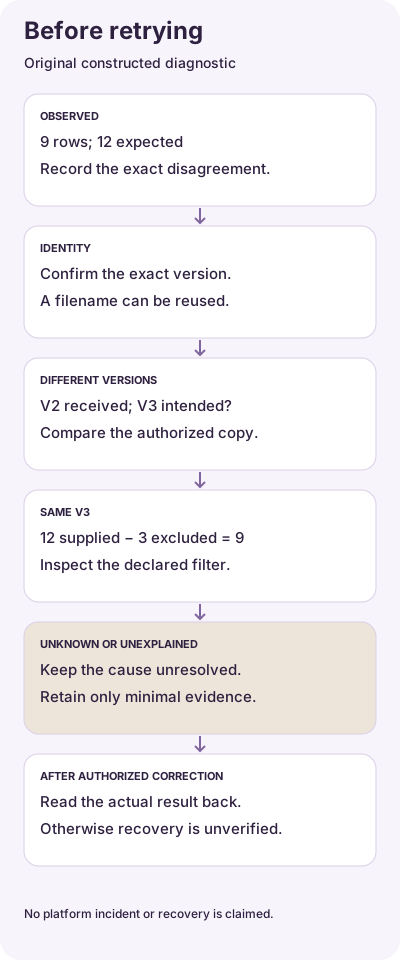
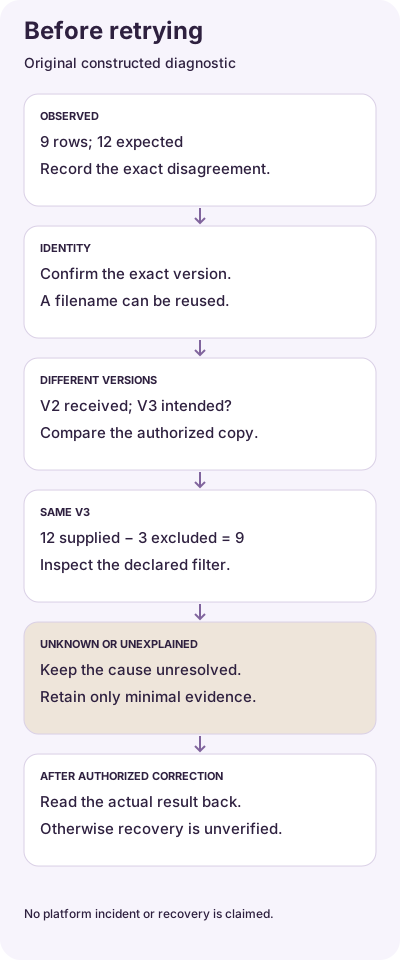
A troubleshooting guide starts where the normal route has already broken. “The recap export has nine rows; I expected twelve” is a useful symptom. “The platform deleted my posts” is a cause claim requiring different evidence. Record exact input/output identity, expected result, observed result and the smallest safe observation that can separate plausible explanations.
Google’s SRE troubleshooting chapter treats diagnosis as hypotheses tested against observations or controlled changes. Our publishing example borrows that reasoning, not its infrastructure implementation. It is an authoring method for a help article, not an actual investigation of LinkedIn or a promise that one decision tree can diagnose every failure.
Give each branch an observable condition
First ask whether the expected and observed files refer to the same source version. Use a minimal non-sensitive identifier or local file hash where appropriate; a filename alone can be reused. If the versions differ, compare the intended source and captured artifact before changing content. If identity is unknown, keep it unknown and request the minimal allowed reference.
When identity matches, check the declared row scope. In our fictional record, version V3 contains twelve rows before a documented filter and nine after it; three are excluded. That reconciles those particular counts. It does not prove that all exports with nine rows are correct. If neither scope nor identity explains the symptom, stop the branch and preserve evidence for an authorized investigation.
| Observed condition | Useful next check | Permitted conclusion |
|---|---|---|
| Identity differs | Compare intended and received version | Version mismatch; recovery unverified |
| Same V3; filter 12−3=9 | Read the three declared exclusions | These selected counts reconcile |
| Identity unknown | Get a minimal allowed reference | Cause and recovery unresolved |
| Same identity; scope does not explain | Preserve minimal evidence; escalate | No diagnosis yet |
Write one complete symptom-to-result route
Complete constructed help text: “Open the local copy and record its version and row count without editing it. Compare V3 with the source named in the handoff. If the received copy is V2, the mismatch is between versions; obtain the intended authorized copy, then recount. If it is V3, compare the filter record:12 supplied rows minus 3 documented exclusions equals 9 selected rows.”
The help continues: “If you cannot confirm a version or find the filter explanation, keep the result unresolved. Retain only the necessary file/version/count/error notes and contact the responsible support route. Do not delete the source, reconnect an account or repeat a publish action merely to make the count change. Verify the intended result after an authorized correction; a submitted request is not recovery.”
Keep resolved and unresolved cases visible
D1 — Constructed version mismatch: the reader has V2 while the handoff specifies V3. The immediate next step is an authorized exact-version comparison, not a claim that data were lost. Recovery remains unverified until the actual intended artifact is observed.
D2 — Constructed scope mismatch: V3 and the 12/3/9 filter record agree. Explain the three exclusions beside the selected total. D3 — Unknown identity: a screenshot shows nine rows but no file/version/filter context. Hold the cause claim and collect the minimal permitted reference. Do not assign a remembered cause from another incident or turn missing evidence into a successful check.
Test the proposed action and the stopping rule
For every suggested action, write what it changes, why it is needed, what would confirm or contradict the hypothesis and when to stop. Prefer inspection before mutation. If a change could destroy a source, transmit private data or repeat an uncertain publication, the guide needs an explicit safe route rather than a casual “try again.” Actual authority and account conditions still govern the operation.
Rehearse the help with a clean fixture, a version mismatch and an unresolved state. A branch is incomplete if it only says “contact support” without naming the useful minimal information or if its success sign is merely a button click. Provide the important diagram content as text. A valid flowchart or passing arithmetic check does not prove that actual readers can recover a real failure.
Save the symptom, tested branch and result
The bilingual packet contains the complete help text, branch table, original diagram and three constructed cases. The worksheet records expected/observed state, identity, scope, hypothesis, minimal test, authority, observed evidence, next action and unresolved result. Keep private artifacts outside public support examples and collect no credentials.
Primary troubleshooting and procedure guidance was read on 1 November 2026. The row counts and version labels are original fictional inputs. No platform incident, private-account action, recovery, data-loss finding or support message occurred. This guide is distinct from the specific video-export inspection guide and from a post-incident review, which asks how a verified event should change the process.
- Name the exact expected and observed result.
- Confirm source/version before changing anything.
- Test the declared scope and one hypothesis at a time.
- Provide a safe correction or an explicit unresolved route.
- Read the actual intended result back before calling it recovered.
Sources & product references
Product details reflect the publication date. External features and interfaces may change.