The short answer
Freeze one permitted source and its supported claims, then map them into complete text, document and video drafts. Preserve the unit, scope and qualification in every output and record which versions need correction together. Repurposing changes the presentation; it does not create new evidence, permission, independent studies or audience results.
What you’ll take away
- Treat the source version and its factual claims as separate from the output formats.
- Write the full caption, page sequence and spoken/visual explanation before designing.
- Keep a correction map so a changed input does not leave old claims in another format.
Choose an owned or permitted source and an actual task
Choose a source you can inspect and legitimately adapt: an owned explanation, cleared demonstration or properly permitted third-party material. Record its exact version, rights scope and intended reader task. Access to a webinar, post or private message is not automatic permission to edit and redistribute it. If the source cannot support the planned claim or sharing basis, hold that part before making derivative assets.
Decide why each output is needed. A short caption can state the answer, a document can support a paced check and a video can demonstrate a meaningful change. Making all three is not mandatory. Our exercise adapts one fictional inspection record for teaching; it does not reproduce a customer’s work, a native-account recording or an observed audience result.
Write the claims that must survive every adaptation
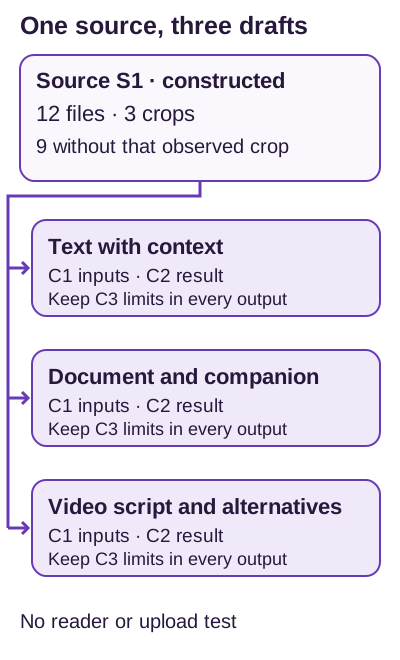
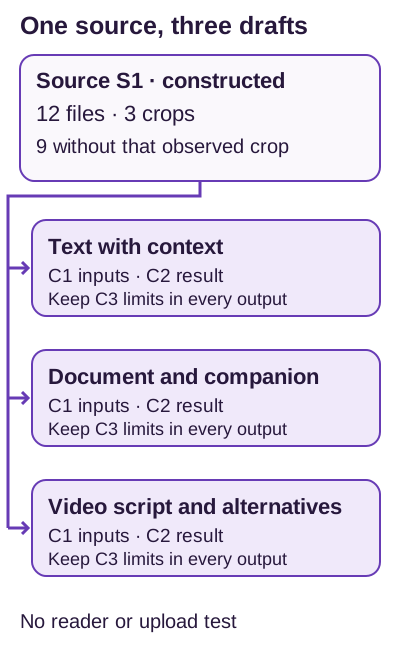
Constructed source S1 says: twelve fictional exports were inspected; three had a cropped period label and nine had no observed crop in that check. No readers or LinkedIn processing were tested. The supported fraction is 3/12 = 25% of the inspected fictional files. It is not a failure rate for all exports or a percentage of people who misunderstood the report.
Map each claim to a source entry and every place it appears: C1 twelve inspected files, C2 three observed cropped labels, C3 the inspection’s fictional scope and unmeasured reader effect. Keep those qualifications close to the statement in text, on pages and in speech. An end-card disclaimer does not repair a misleading headline or an image that omits the denominator.
| Claim | Source content | Retain in every output |
|---|---|---|
| C1 | 12 inspected fictional files | Unit and denominator |
| C2 | 3 crops; 9 without observed crop | Observed criterion and3/12 |
| C3 | No reader or upload test | Fictional scope and unmeasured effect |
Read three complete adaptations before polishing
Complete text draft: “A period label can disappear while a file still opens. In this constructed exercise, three of twelve fictional exports had a cropped period label; nine did not show that crop in the check. The check concerns these files, not reader understanding or LinkedIn’s processing. Before sharing your own report, inspect its actual period label in the exported public copy and keep the source version. A successful export alone does not answer that check.”
Complete four-page document script: page 1 — “Check the period in the actual export. Constructed file-review exercise.” Page 2 — “Inputs: twelve fictional files; three cropped period labels; nine without that observed crop. 3/12 = 25% of these inspected files.” Page 3 — “Open the intended public file, locate the reporting period and compare it with the approved source. Hold an unresolved mismatch.” Page 4 — “No reader or native-upload test occurred. Keep the file/version and check the actual destination separately.” The same text belongs in a readable companion.
Complete short video script: opening — show an owned fictional label and say, “A file can open while its period is cropped.” Middle — show the complete values and say, “This teaching example inspected twelve fictional files: three had cropped period labels, nine did not show that crop.” Finish — show the review action and say, “Check the actual exported label against the source. This is no reader or LinkedIn processing test.” These are scene and speech instructions, not a produced video. Plan synchronized captions, meaningful visual description and a readable transcript as needed; a transcript alone does not replace required AA audio description.
Resolve three reuse failures
R1 — Constructed denominator loss: the text retains 3/12 but a slide says only “25% failed.” Decision: restore the inspected fictional file unit, crop criterion and denominator in the slide and its companion. Outcome: aligned claims across drafts, not evidence that the slide is readable on every phone or that any real exporter fails at that rate.
R2 — Constructed source correction: the approved source changes from three cropped labels to two after a documented review of the fictional fixture. Decision: mark all C2-dependent captions, pages, speech, captions-for-audio and transcripts for review; 2/12 is approximately 16.7%, not 25%. Recheck both locales and preserve the reason/version. Outcome: a dependency and arithmetic exercise, not an actual correction to the supplied original source or to a published post.
R3 — Constructed rights gap: an interview excerpt may be used as a short attributed text, but no video, translation or other editing permission is established. Decision: hold the unsupported adaptations and check the actual agreement; use a separate original general example if appropriate. Outcome: no invented broad consent, recording or customer endorsement merely because one text excerpt was allowed.
Review each actual output and its destination
Keep format-specific checks in the handoff. A document needs actual page order, legible context and a suitable alternative; video needs the complete timeline and appropriate audio/visual alternatives; a caption needs the same factual scope without relying on a cover image. W3C’s media planning guidance differentiates live/prerecorded and audio/visual needs. Changing the format does not make those requirements interchangeable.
After authorized publication, inspect the actual destination and obtainable asset rather than the design canvas or a scheduler preview. A source-to-output map identifies what to inspect but cannot replace that observation. If a material source change affects a file that cannot be replaced in an existing post, use the supported correction path and retain known copy limits. Do not call a removed link a recall of downloaded files.
Keep the editable map and complete drafts together
The packet includes the full source, all three complete draft treatments, an original claim-to-output diagram, bilingual private adaptation records and arithmetic fixtures. Record source/version, rights, claim IDs, unit/period/limits, exact output versions, accessibility work, reviewer decision and destination state. The diagram shows dependencies, not an automated guarantee that every future copy will be found.
Primary content-design and media-planning bodies were read on 1 November 2026. All values, files, scenes and R-cases are invented teaching material. No real PDF, video or native post was generated from these scripts; no person, account, test result or preference was collected. The local checker tests stated fractions and declared dependencies, not production quality, complete rights or reader/business benefit.
- Bound source and adaptation permission.
- Map claims with units and limits.
- Write complete outputs and appropriate alternatives.
- Inspect each actual finished output.
- Trace source changes to all dependent versions.
Follow a correction through actual local files
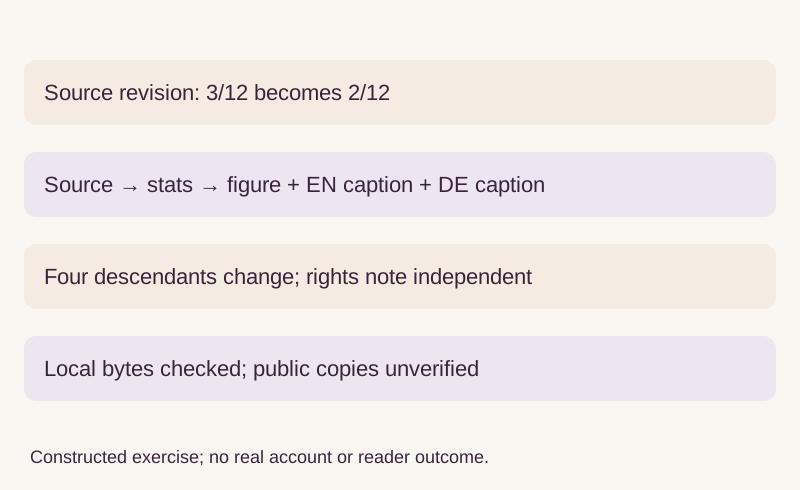
The separate executable extension now supplies the before and after source, statistics CSV, SVG figure and complete English/German captions for R2. Its constructed correction changes 3/12 to 2/12, or 25% to approximately 16.7%. The historical S1 source and original scripts remain unchanged. The new files demonstrate a local correction, not a revised native post, PDF, video or customer report.
The declared input-to-output graph is source → statistics → figure, English caption and German caption. Starting at the changed source reaches four descendant outputs; the separate rights note is not a descendant. Both source versions and their fingerprints are retained. W3C’s PROV primer distinguishes revision from derivation; this small dependency exercise uses that distinction without claiming to be a PROV serialization or an automatic inventory of every copy.
Run check.py in the extracted delivery packet. It reads actual source bytes, fractions, CSV values, SVG visible text and embedded metadata, and both captions. Each of the four before/after output pairs has different bytes. The deliberately partial figure shows 2/12 visibly while retaining the old 3/12 metadata and source fingerprint; the checker detects that mismatch. A correct visible headline alone does not close this local repair.
The graph only finds declared dependencies. Undeclared screenshots, later exports, native previews and downloaded copies remain outside its coverage. Source fingerprints establish which bytes were used, not the truth of the count or permission to publish. Finish the real task by inspecting each relevant authorized destination separately. This is a bounded teaching extension; no reader or business effect was measured.
Sources & product references
Product details reflect the publication date. External features and interfaces may change.