
The short answer
Use a hashtag when it accurately labels the topic or serves a concrete shared convention. Leave it out when it adds noise or implies a subject the post does not address. We have no eligible experiment establishing an ideal number or a guaranteed distribution benefit; judge the actual purpose and observe outcomes carefully.
What you’ll take away
- Name the reader’s topic in ordinary text first.
- Check a tag’s meaning and current behavior before relying on it.
- A higher count after adding tags does not establish that tags caused it.
Choose a purpose more specific than extra reach
A tag can be a concise topic label or part of a real event’s shared convention. Start by writing what it helps a reader recognize. If the post concerns reviewing a product-analysis checklist, a related descriptive label has a clearer purpose than a list of broad popularity words.
LinkedIn describes personalized feed and search relevance. That does not supply a fixed hashtag formula for every account. Avoid treating old interface instructions, follower counts or an anecdotal viral post as current evidence of how your next post will be distributed.
| Question | Use it when | Leave it out when |
|---|---|---|
| Does it describe the post? | The topic is actually explained | It is merely a popular unrelated label |
| Is there a real shared convention? | The organizer uses this exact relevant tag | You are guessing an event affiliation |
| Does it improve reading? | It adds a useful concise label | A long tag list obscures the message |
| Can you defend a performance claim? | A suitable observed comparison supports a limited statement | The claim rests on one impressive post |
Inspect the words and destination
Check spelling and ambiguity. If a tag opens a destination in the current interface, inspect what it actually shows rather than promising that it always leads every reader to the same collection. Search can be personalized, and platform features can change. Do not prescribe a missing follow or filter control as a required step.
For multiword labels, using visible word boundaries such as #ProductAnalytics can make the phrase easier to parse than an undivided lowercase string. Keep the topic in normal prose as well. A tag should not be the only place a necessary concept, source or accessible explanation appears.
Apply the decision to a fictional recap
A fictional recap describes how a team clarified the owner field in a review checklist. The useful subject is the handover decision and its explanation. Adding #Viral, #Success and an unrelated conference tag would broaden the implied subject without adding evidence.
A deliberate choice could be one relevant descriptive label, the actual event’s agreed label if the post truly concerns that event, or no hashtag at all. These are examples of a relevance decision. They are not a measured recommendation that one or two tags maximize impressions.
Keep an observation plan modest
If you want to investigate your own use, write the question before looking for winners. Record the exact text and tags, topic, format, account, publication time and comparison age. Choose a relevant outcome, such as useful qualified replies, alongside any available distribution metric.
Preserve all eligible observations and unavailable values. Changing the opening, topic, media and tags at once makes attribution especially difficult. Repeated natural posts can inform a personal description, but a small nonrandom series does not isolate the effect of hashtags. Avoid calling a before/after difference an algorithm discovery.
Revisit the choice when the purpose changes
Before publishing, read the full post without the hashtag line. The claim and useful next step should still be clear. Verify event associations and names, then inspect the actual published result if you intended to publish it. A generated list alone provides no evidence of relevance.
Keep only a workflow that serves the reader and a comparison you can describe honestly. Wrapped.li does not reconstruct private impressions from public reactions, certify a hashtag’s distribution or establish an account-wide growth effect from a recap. Use the source and metric suited to the question you actually have.
Compare the exact revision before using its tag line
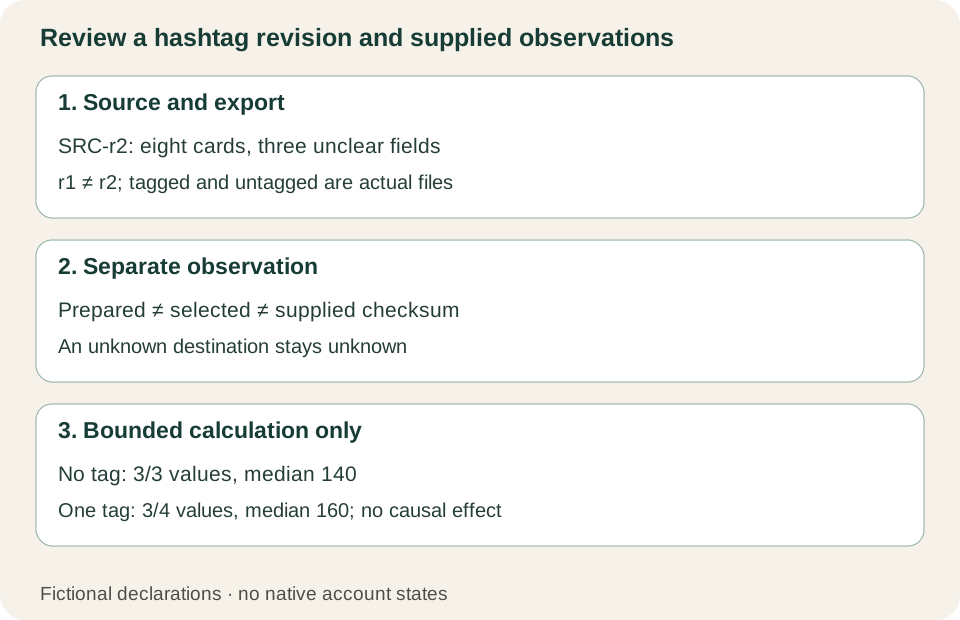
The downloadable exercise keeps an earlier r1 draft, the current r2 draft and a current version without a hashtag as six actual English/German text files. Its fictional source concerns eight handover cards: r1 records two unclear owner fields; r2 records three. The tag line also changes. A correctly named old file therefore still carries an older statement. Read the whole text against the current source before choosing a label or copying the post.
Start with the source, review and export as separate records. Our local review holds T2 when an old file is supplied despite a current review; T7 uses the actual current untagged file. A checksum can identify exact bytes, but cannot decide whether a topic, event association or promise is true. The text without its tag must still explain the useful subject. These are local teaching drafts, not uploaded or published posts.
- Extract the complete packet and read its source declarations before choosing a draft.
- Compare r1, r2 and the untagged r2 file in your language, including quantities, context and the last line.
- Keep the reviewed revision and selected file separate; a prepared file does not establish a selection or publication.
- Use the private blank record for your own review; keep unresolved source or identity fields open.
Keep a relevant label separate from an observed destination
T1 uses #DemoReviewRoom because the fictional declarations give it a specific shared convention. This is not a real event, an exclusive right to that tag or a guarantee of a complete archive. T3 declares a popular label unrelated; T4 leaves another label's meaning unresolved. Those are supplied editorial judgments, not meanings discovered by the checker. A generated list and plausible spelling do not settle the question.
The twelve records keep the proposed member/post, actual local file, separately supplied selection/readback checksums and destination context apart. T5 has no supplied destination, T6 targets the wrong member and T8 has only prepared bytes. Even matching supplied checksums establish only a match with the local file, not an inspected recipient copy or native publication. The current official search task allows typed hashtags while omitting hashtag autosuggestions; neither statement tells us what a private member's destination currently shows.
Retain missing values and the denominator when describing results
The separate fictional metrics file contains eight registered rows. The declared comparison uses the same member, text format and an age of 168 hours: seven rows qualify. X1 is only 24 hours old and stays in the file but outside that comparison. Without a tag, all three impression values are available and their median is 140. The one-tag group has four eligible rows, only three available impression values and one missing value; its available-value median is 160. The table keeps those denominators visible.
T10 refuses to reconstruct the missing impression count from replies, and T11 keeps impressions separate from unique people. Dropping the low H1 row would raise the available one-tag median from 160 to 230; that is selective omission, not better performance. Reply medians are 1 and 0.5, so even the descriptive direction depends on the chosen outcome. These supplied nonrandom rows establish no hashtag effect, optimal count, buying intent or real reader preference. The packet's local checks do not replace source judgment or an actual permitted interface check.
| Declared group | Eligible / available / missing impressions | Median available impressions | Reply median (available counts) |
|---|---|---|---|
| No tag | 3 / 3 / 0 | 140 | 1 (3) |
| One tag | 4 / 3 / 1 | 160 | 0.5 (4) |
Sources & product references
Product details reflect the publication date. External features and interfaces may change.


