
The short answer
Start with the person and professional context you actually mean, use the native People results and available filters, then inspect the candidate profile against your permitted reference. Treat search rank, a similar name and approximate result counts as clues. If the evidence cannot distinguish candidates, keep the identity unresolved and do not attribute a quote, merge records or contact someone on that basis.
What you’ll take away
- Search retrieves candidates; it does not establish identity by rank.
- Use only relevant known professional clues and record uncertainty.
- A profile link can identify the inspected destination without proving every real-world claim.
Write the person-finding question first
A useful small task is to locate the profile linked by a speaker in an authorized event reference, or revisit a known collaborator before attributing their contribution. Record the original clue and why identity matters. This is different from finding a post or deduplicating archive rows: the result must be an inspected candidate destination or an explicit unresolved search.
Use relevant information you already have permission to use, such as a supplied profile link, professional role or organization context. Do not fill a missing clue with an inferred email, sensitive characteristic, private address or scraped dossier. If your task is simply to credit a public contribution, the original contribution reference may be more useful than guessing a current employer.
Retrieve candidates in the actual available search
LinkedIn documents entering keywords or a natural-language query, opening results and selecting People. Available filters can narrow the professional context. Its help says result counts are approximate. Record the actual query, mode and filters you used; the presence of instructions does not prove that every filter or updated search mode is available in your account.
The same help distinguishes conversational search from exact keyword matching and says natural-language queries do not support quotation marks. Keep those modes separate rather than expecting one syntax to have the same meaning everywhere. This guide does not promise a universal Boolean query, paid entitlement, exact count or exhaustive list of all people matching a role.
- Write the known permitted clue and intended task.
- Open the native search and use the People results.
- Apply only relevant filters actually available to you.
- Open plausible candidates and compare the permitted reference.
- Retain an inspected destination or an unresolved reason.
Compare the candidate with the reference, not the first result
Read the actual candidate profile and compare the reference that matters: a directly supplied destination or clearly supported professional context. A matching name and city may fit several people. A changed role can make an old affiliation clue stale. A search snippet and remembered face are not enough to assert that an ambiguous candidate authored a statement.
Separate destination identity from claim verification. A supplied link that opens the intended profile establishes that inspected destination, subject to the actual observed account context. It does not verify credentials, current employment, ownership of another account or the truth of every profile claim. A sign-in prompt or unavailable view leaves an access limit, not proof that the person does not exist.
Resolve three constructed searches without inventing a match
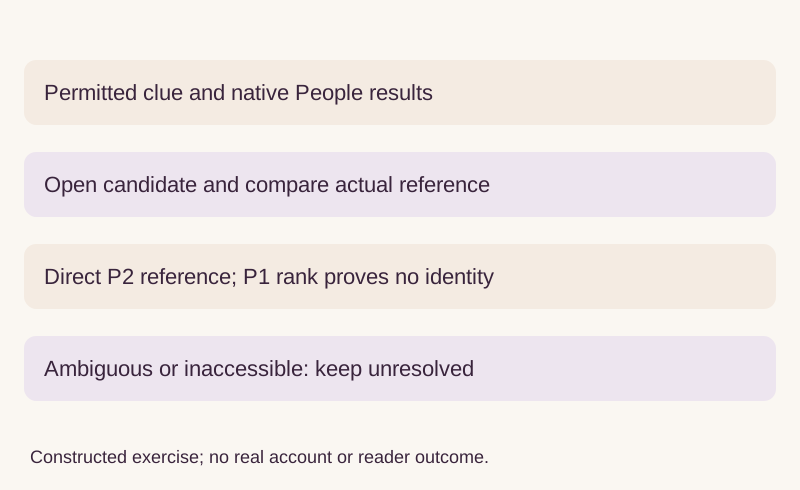
S1 — The fictional authorized reference points to candidate P2. P1 and P2 share the same invented display label, and P1 ranks first. Decision: inspect P2 through the supplied reference and record the observed destination. Result: first position contributes no identity rule. The packet uses opaque candidate tokens, not real people or working profile links.
S2 — The only clues are the same label and broad professional area; P1 and P2 both fit. Decision: keep both as candidates and identity unresolved. Do not assign either person’s quote, merge records or send a message to force a result. Result: ambiguity preserved, not a failed person or a fabricated match.
S3 — The reference identifies P3, but the destination is unavailable in the observed context. Decision: preserve the permitted reference and mark content unverified. If the task requires an actual quote or current role, hold that claim until its source can be checked. Result: a reference was located; no current profile contents, deletion or real-world identity conclusion is invented.
| Constructed clue | Bounded result | Unsupported leap |
|---|---|---|
| Direct P2 reference; P1 ranks first | P2 destination inspected | First result must be the intended person |
| Two candidates fit broad clues | Identity unresolved | Same label means same person |
| P3 reference; destination unavailable | Reference retained; contents unverified | Person absent or profile claims verified |
Handle an empty or changing result deliberately
Check whether you selected People and whether one restrictive filter contradicts the known clue. Relax one condition at a time and record the change. Prefer a trusted already-supplied link when one exists. Avoid repeated account switching, bulk collection or invented lookups when the task can remain unresolved.
An approximate result counter cannot establish a complete population, a distinct-person total or whether a specific person has an account. Likewise, two different URL spellings do not by themselves establish two people. Keep search observations separate from any later private record reconciliation. Returning many candidates is retrieval, not completed identification.
Retain the smallest useful search record
The editable record keeps task, permitted clue, actual query/mode/filters, candidate references, inspected evidence, unresolved reason and the claim you may now make. Do not turn it into a public contact list. Record the observation time because search and profile details can change. No numeric matching score substitutes for the missing authoritative clue.
English and German primary search instructions were read separately on 1 November 2026. All packet candidates and outcomes are constructed. No real profile was looked up, scraped, merged or contacted, and no account search mode was exercised. The workflow supports a bounded identity decision; it is not an identity-verification service, recruitment campaign or measured reader/customer result.
Sources & product references
Product details reflect the publication date. External features and interfaces may change.


