
The short answer
Read the group’s purpose, rules and public/private state before requesting membership or drafting a contribution. Requested, joined, submitted for review and published are separate states. Group access does not by itself authorize copying another member’s discussion into a public recap.
What you’ll take away
- Choose a group for a specific learning or discussion task.
- Inspect membership and post-review states separately.
- Keep private discussions within their intended audience.
Check purpose and audience before joining
Name the question you want to discuss and read About this group, rules and recent relevant activity where accessible. A large membership number is not proof of useful discussion or the right audience for your recap. Existing membership and a recommendation to join are different facts.
Inspect whether the group is public or private, and listed or unlisted where relevant. Public visibility and member posting rights differ. Do not infer confidentiality solely from an unlisted address; the audience, rules and actual sharing permissions still matter for a source or screenshot.
Request membership and inspect the actual state
The finding/joining help uses native search and its Groups filter, then the group’s own request-to-join action. Managers may review or ask for more information. A request is not an accepted membership. Inspect the current group page instead of assuming a successful click grants access.
The creation help describes public groups as publicly readable with member posting/commenting, and private groups as member-readable. Use that distinction when choosing material for a contribution. If access is unavailable, do not obtain another person’s credentials or copy a private discussion through an unrelated service.
Draft a contribution that answers the group’s question
Begin with the relevant question, a useful observation and the limit of your evidence. A link should support the explanation rather than make the group a distribution list. A self-contained recap lesson can say what changed and ask one bounded follow-up without claiming that every member needs the product.
Read any required approval state before expecting the post to appear. The moderation help says enabled post review leaves submissions pending until admin action. A saved draft, pending submission and visible post are different outcomes. Keep the original text privately while a review is unresolved.
Resolve three participation decisions
G1 — Constructed pending membership: a request was submitted but the member cannot read the private group. Decision: inspect the request state and wait for the actual membership decision. Result: pending access, not an empty group or a failed content search.
G2 — Constructed private lesson: a useful comment in a private group changes a creator’s explanation. Decision: keep the original discussion private and resolve public quotation permission; a general process lesson may stand without the person’s words. Result: held quote, not assumed public reuse.
G3 — Constructed post review: the composer accepted a contribution and shows pending approval. Decision: keep the submitted text and review state, without repeated reposting. Result: submitted, not published; no measured readership or preference follows from the submission.
Review useful replies without turning them into a survey
A reply can suggest a clearer example or missing definition. Preserve the specific observation and selection context. Do not call a few voluntary comments a representative audience study or infer that silent members agreed. Give credit only within the allowed public scope.
If the group no longer fits the reading task, use the current membership controls deliberately and retain only needed private notes. Leaving, notification suppression and removal of a previous post are separate matters. Check the actual item if a correction or removal is required.
Keep one private contribution record
The worksheet records purpose, privacy/rules, membership, draft, approval/publication and allowed follow-up. Keep identities and inaccessible discussion text out of a public example. An unresolved permission stays unresolved even when a post is visible to you.
Sources were read on 1 November 2026. Every case is constructed; no group was joined, posted to or contacted. This method does not establish group quality, reading comprehension or customer acquisition.
Execute seven membership and contribution records
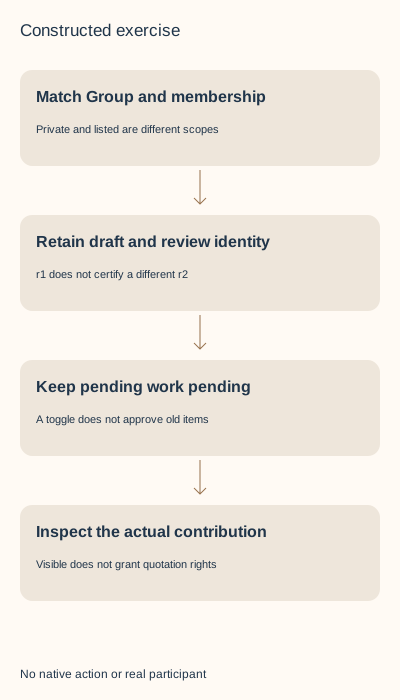
P1 supplies a pending membership request to a private group: keep access unconfirmed. P2 supplies private listed-group access and a proposed public quotation without permission: hold that reuse. Discoverability is different from public post visibility. The German creation table uses Öffentlich for listed private-group discoverability; that label does not make the discussion public.
P3 supplies a contribution pending review. P4 supplies review switched off while that same contribution remains pending. Keep both pending states; the moderation task says disabling review does not release existing pending items. It describes deletion of pending posts older than 14 days, but our exercise makes no exact-boundary native test and infers no deletion from a missing notification.
P5 changes a real teaching draft from 12 to 15 reviewed sources while retaining a review of r1. Hold the claim that this old editorial review certifies r2. This is our review safeguard, not a native rejection: LinkedIn says edits to approved posts do not require fresh admin approval. P6 supplies the matching r2 review and an observed r2 post in a private group; retain only that fictional visibility. P7 supplies a public-group submission without an observed post. Neither source visibility nor submitted text proves publication, reader understanding or permission to quote another person.
Use the exact drafts and a private contribution record
The local packet supplies seven Group rows alongside nine separate Messaging group-chat rows, two actual text drafts, separately retained review identities, complete bilingual decisions, four diagrams and blank records. Extract and run python3 check.py with existing Python 3. The standard-library rebuild checks exact group/member, contribution bytes, reviewed revision, chronology and supplied observation. It performs no network request, join, invitation, post or moderation action.
Keep purpose, exact group/privacy and discoverability, membership, draft/review identity, submitted state, actual post state and any public-reuse permission in the private worksheet. A visible item is not measured reader value; no rejection notification is not approval. Current membership, creation and moderation sources were read in both languages on 2 November 2026. This extension preserves the original guide and cover and adds no topic, formal research piece, distinct aid type, native UI/download or genuine reader/customer evidence.
Sources & product references
Product details reflect the publication date. External features and interfaces may change.
- LinkedIn: Find and request group membership
- LinkedIn: Public/private group scopes
- LinkedIn: Group post review states
- LinkedIn: Current Group participation boundary (a544795,de)
- LinkedIn: Current Group participation boundary (a541569,de)
- LinkedIn: Current Group participation boundary (a550350,de)
- Original constructed chat and Group contribution records


