
The short answer
Build the program around a useful resource and explicit choices to read, contribute, publish independently or decline. Give source maintenance, factual review and publication their own owners. Keep personal-account participation optional, review the exact version and stop an unresolved release. A program plan, employee notification and public contribution are different states; none proves reach or business impact.
What you’ll take away
- Start with a resource people can use, rather than a required reaction or repost.
- The retired Employee Advocacy tab is not the operating model for a new program.
- Record voluntary decisions and resource quality without ranking employees by engagement.
Choose the help the program should provide
A small program might maintain a clear public explanation that staff can consult when someone asks about a report. That is a usable purpose even if nobody posts about it. Define the reader question, source owner, permitted material, available support and a review date. Treat hoped-for attention or recruitment as an unmeasured outcome rather than the acceptance condition for an individual employee.
This is an ongoing coordination task, beyond sending one Page notification or approving one post. Decide who maintains the shared resource, how factual changes reach its working versions and when to pause or end the arrangement. Make declining or leaving a real option. A manager’s enthusiasm, a shared employer or a public profile affiliation is not agreement to publish from a personal account.
Use current controls instead of a retired tab
LinkedIn’s retirement notice says My Company, Employee Advocacy and the curator role began discontinuation in November 2024. Do not write a new operating plan around those old tabs or treat its pre-November-2024 export deadline as an action still available today. The notice is historical product guidance, not proof that an old dataset can now be recovered.
Employee Notifications are a separate documented Page-post action. They are selective, can take hours and allow opt-out; a status label is not a list of everyone who read the post. Use the dedicated notification guide if an eligible Page post genuinely warrants that action. Do not change an employee’s profile or demand a public repost to make a program appear active.
Write a complete small charter before inviting participation
Our original fictional charter P1 offers an owned field-definition note, version V2, to help explain current follower stock versus new follows. Role O maintains the source; role R checks the definitions; role C coordinates the review. These are unassigned teaching roles, not real staff. The charter offers reading only, proposing an edit, writing an independently reviewed contribution, or declining. None requires a reaction or endorsement.
The charter includes a bounded support period, minimal working records and a stop rule: hold affected material if the source is withdrawn, a material fact changes, private information appears or publication authority is unresolved. A person who wants to contribute can choose their own wording and reject a proposed edit. Keep employer relationship and factual responsibility understandable rather than manufacturing a personal testimonial.
| Choice | Useful support | State to preserve |
|---|---|---|
| Read only | Source note and a route for questions | No public action expected |
| Propose an edit | Exact draft and factual reviewer | Suggestion is not approved publication |
| Consider an own contribution | Permitted source and voluntary version review | Publishing remains a separate intentional action |
| Decline or leave | End the optional work without an engagement target | No failed-performance label |
Resolve three different participation decisions
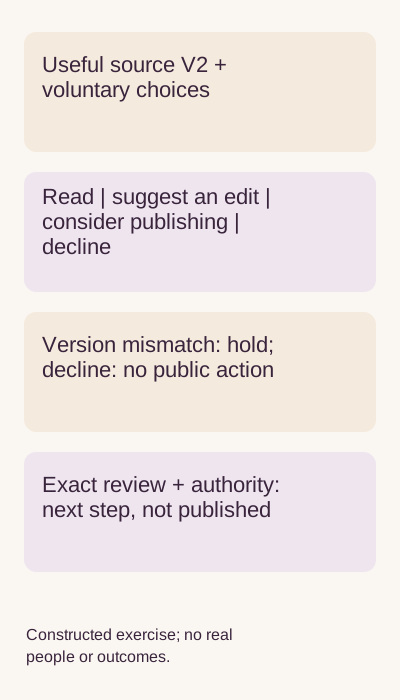
P-A — A fictional choice record says decline. Decision: no draft assignment, scheduled post or request for a reaction follows from that choice. Result: participation declined, not a failed employee or missing conversion. The packet’s local checker tests that branch using supplied tokens; it has no employee list or contact capability.
P-B — A volunteer wants to suggest an edit, but the working text is V1 and the approved source is V2. Decision: hold that draft for the changed facts and record the exact reviewed version. Result: an edit request with a source mismatch, not permission to post an obsolete claim.
P-C — A volunteer’s V2 draft has the specified factual review and intended-account authority in the fictional ledger. Decision: it may proceed to the separate deliberate publishing step. Result: ready for that step, not published, delivered, read or preferred. A future actual post needs its own observed destination and any material correction needs its own follow-up.
Review resource usefulness and workload without surveillance
At the agreed review point, examine actual questions, necessary corrections, support work and whether the resource still answers its purpose. Keep a permitted minimal issue log instead of collecting private messages or ranking people by public reactions. Participation choices and a platform’s associated-employee count have different definitions; do not combine them into an invented adoption rate.
If you report a program-level outcome, name the measured unit, eligible scope, observation window and missing evidence. A handful of voluntary posts cannot isolate an effect on sales, retention or hiring. If the work produces pressure or consumes more time than agreed, revise or stop it. Continuing a program is a decision to justify, not an obligation created by the initial plan.
Keep the charter, versions and exit decision together
The packet contains the full bilingual charter, three complete cases, a blank private program record and a limited branch checker. Record purpose, source/version, contribution choices, review roles, publication boundary, support capacity, stop conditions and actual review or exit state. The checker confirms the declared fixture decisions; it cannot establish voluntary consent, legal permission, staff wellbeing or the accuracy of new text.
Current primary help was read on 1 November 2026. These are original constructed planning materials. No employee was invited, assigned work, notified, evaluated or contacted; no organization’s program was launched. The resource supplies a bounded operating plan and does not establish real reader preference, engagement lift or customer value.
- Define one useful resource and its owner.
- Offer genuine participation and exit choices.
- Review exact versions and publication authority.
- Hold unresolved facts, access or privacy issues.
- Review actual workload and evidence before continuing.
Sources & product references
Product details reflect the publication date. External features and interfaces may change.


