The short answer
Agree what the shared resource should help a reader do, who contributes what and which versions each person can review and maintain. A collaboration brief makes dependencies visible; it does not create authorship, copyright permission, platform access or a completed partnership.
What you’ll take away
- Connect each deliverable to a named contribution and responsible owner.
- Let contributors review proposed credit without assigning unearned authorship.
- Plan changes, publication authority and withdrawal before relying on the result.
Agree the reader job and the bounded resource
A useful purpose is “produce a public example that distinguishes current follower stock from period gains.” “Grow both audiences” is an unproven hoped-for result. Define the source, proposed outputs, languages, deadline dependency and what is excluded. State whether there is any payment, referral or promotional arrangement and what still needs appropriate review; a free collaboration still consumes time and can imply endorsement.
Begin with the actual people and accounts willing and authorized to take part. A tagged profile, accepted connection or shared employer is not agreement to collaborate. This guide supplies a working brief, not an invitation list or permission to contact anyone. No real collaborator was recruited for the examples.
Describe work and credit separately from authority
CRediT classifies contributions to scholarly research and allows several roles per contributor and several contributors per role. It does not determine authorship. Our creator brief adapts the transparency principle: describe actual drafting, visualization, checking and coordination in ordinary language. Proposed credit should be reviewable by the people concerned; a role label does not transfer rights or show that the person approved the final resource.
Keep three columns: work performed, evidence/version and authorized responsibility. Someone who checked two definitions need not own every claim; someone who manages a schedule may not be able to publish on the account. Separate factual review, permission review, final wording and native publication. Use local role codes in a public teaching example rather than invent named endorsements.
Work through one complete dependency map
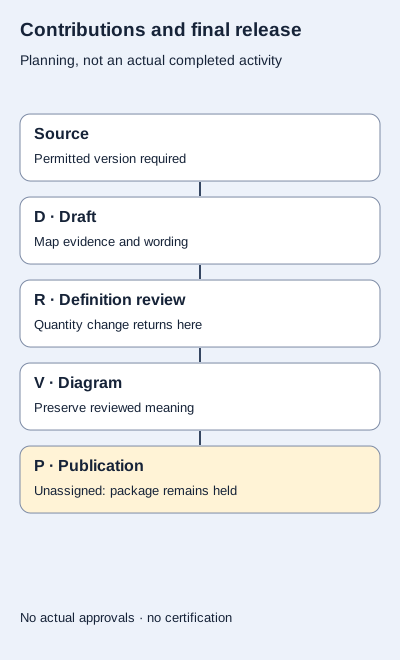
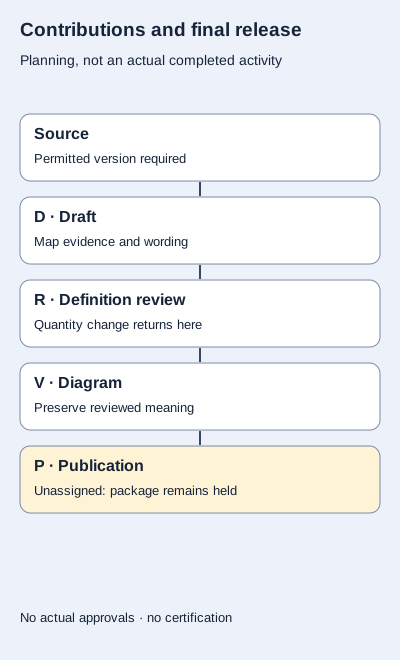
Constructed brief C1 has three roles: D drafts source explanation v1, V turns approved text into a diagram, and R checks definitions against the permitted source. D owns the working document; R can request factual repair; V owns the diagram source file. Publication owner P is deliberately unassigned. The brief is held until actual publication authority and the exact final versions are agreed.
The handoff is source → draft → factual review → diagram → final package. Diagram changes that alter a quantity return to factual review. A typo correction may need a narrower check, but the person choosing that scope must record why. Proposed credit says “drafting D; diagram V; definition review R,” not “three independent validators” or “everyone approved every claim.” No real work or permission is represented by these codes.
| Role | Contribution | Authority boundary |
|---|---|---|
| D | Draft | working text |
| R | Definition review | not all claims |
| V | Diagram | quantity changes return to R |
| P | Publication | unassigned: held |
Resolve three collaboration failures
C-A — Constructed borrowed authority: R reviewed two labels and the draft advertises an independently certified report. Decision: narrow the public credit and remove the unsupported certification. Outcome: traceable contribution wording, not an independent review claim.
C-B — Constructed version drift: V changes a denominator after R checked the text. Decision: hold the changed package and return the affected claim and outputs for review. Outcome: the previous approval is not stretched to cover a materially different version.
C-C — Constructed exit: D withdraws a private source before publication. Decision: stop dependent release and determine what can legitimately remain, be replaced or be deleted. Preserve necessary minimal decision evidence without publishing the withdrawn material. Outcome: an exit plan, not legal clearance or an actual withdrawal.
Agree final review, maintenance and exit
Record the exact proposed text/files, destinations, identity, timing, credit, necessary disclosures, review decision and unresolved issues. A “looks good” attached to an earlier draft is ambiguous. Use the separate content-approval guide to review a real final post. Do not infer LinkedIn coauthor support, account permissions or an endorsement feature from this generic working brief.
Name who will correct each public copy and what happens when someone becomes unavailable. Decide how to retain only necessary source and decision references, recover editable files and communicate a material correction through permitted channels. If the arrangement needs legal or commercial terms, obtain the appropriate agreement; this worksheet is not a contract or a substitute for permission.
Keep a contribution record that survives handoff
The blank brief covers reader purpose, people/authority, inputs, contributions, dependencies, version review, proposed credit, permission/disclosure questions, maintenance and exit. The original diagram and local fixture show the held publication owner and the return path after a quantity change. They do not prove consent, independent validation, source ownership or a live partnership.
CRediT pages were read on 1 November 2026. Its scholarly definitions are acknowledged in their scope; our creator workflow is an original adaptation. All C-cases and role codes are constructed. No collaboration message, native post, credit assignment or payment was made.
- Record the task, scope and actual authority.
- Inspect inputs and evidence state at the actual source.
- Work through the full proposal with dependencies and unknowns.
- Record the decision, owner and next permitted step.
- Verify actual results separately from plans and constructed examples.
Sources & product references
Product details reflect the publication date. External features and interfaces may change.