
The short answer
Inventory the old resume by content and destination before replacing it. A file saved for future applications, a Featured work sample, an externally hosted document and a previously submitted application are separate copies. Review and retire each controlled surface deliberately. Keep already submitted or downloaded copies outside any claim that replacing one saved file recalled the old version.
What you’ll take away
- One filename can refer to several independently stored versions.
- Removing a Featured entry and deleting an application-storage file have different scopes.
- Keep unresolved copies visible without claiming complete erasure.
Define which version should stop being offered
Start with a concrete correction: perhaps an old role date, outdated portfolio link or contact detail should no longer appear in the resume you offer now. Open the intended replacement and verify its factual contents. Keep the revision purpose and a minimal private identifier for the old and new documents. A filename such as resume-final.pdf does not tell you which bytes an earlier recipient received.
The task ends when the specific controlled surfaces have an observed state and uncontrolled copies remain honestly bounded. It is not the application-send workflow or a guide to generating a profile PDF. Avoid uploading a full personal resume into an unrelated service just to compare two versions; local inspection usually answers that narrow question.
Give each destination its own line
LinkedIn documents application storage and profile display as different upload routes. A profile upload is not reused as the application attachment. Its resume help also says deleting a stored resume does not affect previously submitted applications. These documented boundaries are the reason to inventory copies rather than assume a single master resume.
Add a profile work sample, an external portfolio destination and any known already-submitted version to the record when relevant. The same source file can populate several surfaces, but each later replacement needs its own check. Record only the minimal destination reference, version and intended action; the worksheet does not need your address, full employment history or a list of recruiters.
| Surface | Retirement question | Evidence to retain |
|---|---|---|
| Future application storage | Is the obsolete stored attachment still offered? | Actual stored-file list and selected version |
| Featured sample | Does the profile still present the old sample? | Reopened profile entry and destination |
| Controlled external document | Does the intended link return the reviewed replacement? | Actual destination and file contents |
| Already submitted or downloaded copy | What change, if any, is actually confirmed? | Known version; recall remains unestablished |
Use the control for the object you actually mean
The resume help places stored-file deletion in Job Application Settings or Resumes and application data. Its deletion heading mentions a profile, but the steps point to application storage. Treat that wording carefully: it does not establish that the same action removes a Featured card. Inspect the real object and confirmation before an intentional removal.
The separate work-sample help distinguishes removing a sample from Featured from deleting it. Choose the action that fits your intention and verify afterward. Featured also has sign-in and source-visibility limits; do not promise that a member without a LinkedIn account can open it. An external document’s own access rules remain another boundary. This guide has not changed a real profile or uploaded a resume.
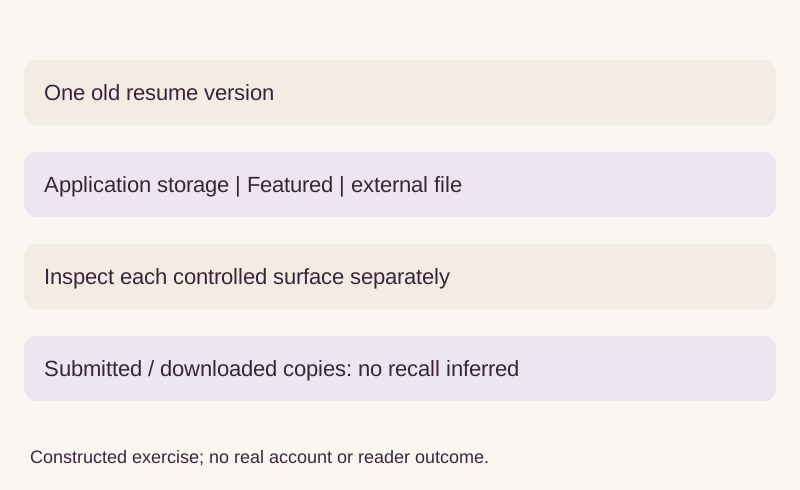
Complete three constructed retirement decisions
L1 — The replacement is reviewed locally, but the old file remains in future-application storage and as a Featured sample. Decision: keep both destinations pending; perform only the intended authorized changes and reopen each. Result: local readiness is recorded without inventing a completed account update.
L2 — The Featured card is removed, while its external URL still returns the old resume. Decision: record the card removal separately, then inspect whether you control that external destination and want to replace or withdraw it. Result: profile presentation can be retired while the linked file still exists. Removing a pointer is not a verified deletion of its target.
L3 — Future storage now offers the reviewed file, but an earlier application used the old one. Decision: retain the submitted version in the minimal application record; use the actual appropriate correction route if needed. Keep any correction request distinct from confirmation. Result: future reuse updated; an already submitted employer copy is not claimed to have changed.
Review links, details and the replacement itself
Open the replacement as the recipient will obtain it when an authorized check is possible. Read dates, work claims and needed contact information; follow the important portfolio/profile links in an appropriate context. Check the actual attachment rather than a thumbnail or local draft. If you change a profile URL, update the document source separately and inspect the new export.
A simplified professional document can omit unnecessary private details without claiming that every old copy disappeared. Keep only the authorized evidence needed for this version handoff, and apply your own appropriate retention decisions to private working copies. This is a document-maintenance method, with no promise of hiring, legal deletion rights or universal platform retention behavior.
Finish with a per-surface receipt
The blank record has one line per surface: old/new version, actual object, intended action, observed result, check time and unresolved copies. It keeps prepared, requested and inspected states apart. If you cannot inspect a destination, mark it unverified instead of copying another row’s completion. Avoid retaining unnecessary screenshots of personal material.
English and German primary help were read separately on 1 November 2026. The packet’s three lifecycle cases are fictional and contain no real resume, account, employer or recipient. No upload, application, removal or message was performed. The record supports an explicit handoff; it establishes no actual reader preference, hiring result or customer value.
- Identify the old and reviewed replacement contents.
- Inventory application, profile and external surfaces.
- Choose the supported action for each intended object.
- Reopen each changed surface and inspect the actual file or entry.
- Keep already distributed and unverified copies outside completion claims.
Sources & product references
Product details reflect the publication date. External features and interfaces may change.


