
The short answer
Confirm that both profiles are your own member accounts and choose which identity should remain. Review access, confirmed primary emails, connection limits, nontransferring data and applicable obligations before using the official support route. The help describes a limited connections/email transfer, not a whole-profile copy. A zero-connection duplicate has a separate closure and later email-addition branch. A request receipt is not a completed merge or proof of the retained count.
What you’ll take away
- Choose retained versus source account explicitly; names and email conflicts are insufficient.
- Recommendations, endorsements, profile content and other listed objects do not follow the connection transfer.
- Start the 48-hour empty-account email wait from observed closure, not from a draft.
Prove ownership before choosing the retained account
An older account may hold professional connections while a newer one contains the profile you currently maintain. Begin with the exact own account references and the identity you intend to retain. A matching display name, an email conflict or a missing count is not enough. A secondary profile language is part of one account, and two company Pages use a different consolidation policy.
Keep the account directions explicit: retained account K, source account S. The current duplicate-account help requires access to both and confirmation of both primary email addresses for its accessible-account route. If either owner or access is unresolved, use the relevant official recovery/support branch before planning closure or transfer. Do not create another account to resolve the uncertainty.
Read the limited transfer and the actual offered route
For two accessible accounts, the current help directs the member to contact LinkedIn support with the account URLs and access information available. The same document still uses self-merge wording when limiting what transfers to connections and the email address. Preserve both descriptions. They do not establish that a self-service merge button is available now or that a prepared request was accepted. Keep credentials in the official sign-in context, not in a worksheet or a copied support narrative.
The source excludes merging accounts with zero connections or more than 30,000 connections. It also says InMail credits are lost. Keep these member-account conditions separate from Page follower rules. Two visible connection totals do not prove the eventual retained total: overlap, actual transfer and the platform’s resulting count have not been observed in our exercise.
The nontransferring list includes profile text/media, edits, endorsements, recommendations, saved articles, group memberships and pending invitations. A local copy preserves only what it actually contains; it does not install those native objects in the retained account. Do not call a transferred connection evidence that the whole profile or endorsement history survived.
Finish preservation and responsibilities before requesting consolidation
The duplicate-account help warns that data associated with the source account will be purged and suggests downloading needed records first. Inspect the actual necessary archive/files before losing access. An archive requested or delivered but unopened does not complete that preservation decision. The existing connection-export guide explains its file and field limits; do not treat that CSV as every saved article, recommendation or media item.
Review the source’s applicable prerequisites: Premium subscription, outstanding job postings/listings, advertising campaigns, upcoming events you organize and group ownership. Keep each responsible product or owner and actual result distinct. This guide performs no cancellation, event change, ownership transfer or support submission. A checkbox in a local plan cannot prove that those dependencies ended.
Handle an empty duplicate as a separate closure branch
The help gives a separate branch when both accounts are accessible and one has zero connections: identify that zero-connection account, review its needed data and close only the intended duplicate through Account preferences and Account management. Zero connections does not prove there is no profile content or other material worth preserving. Read the actual final screen; closing a populated account is not a way to transfer its network.
For that closure branch, the help says to wait 48 hours after the account is closed before adding its email to the remaining account. The clock starts at observed closure, not a plan or support receipt. Our exercise holds a 24-hour interval and leaves an exact 48-hour boundary untested. At 49 hours it records only that the stated wait has elapsed; address availability, ownership, confirmation and actual addition remain separate checks.
Work through ten constructed consolidation decisions
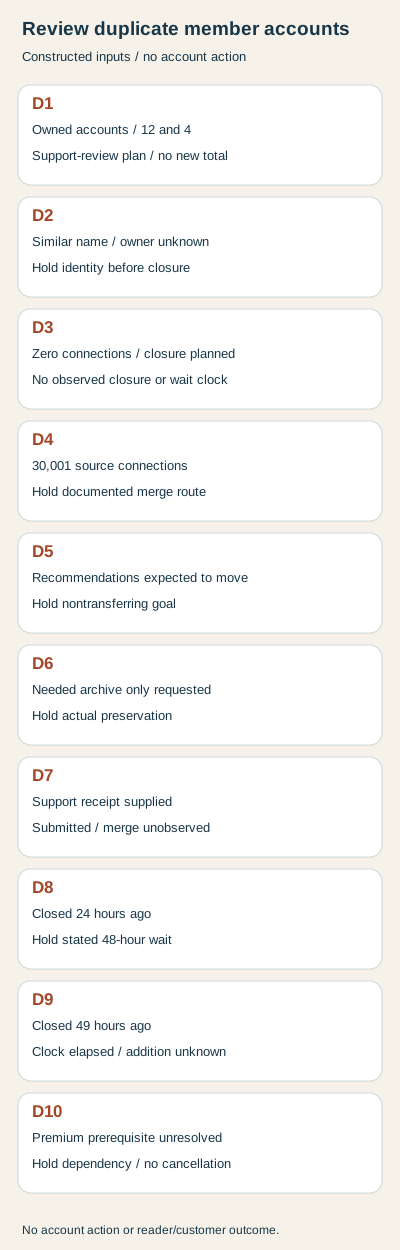
D1 supplies two owned, accessible accounts with confirmed primary addresses, 12 and 4 connections, resolved dependencies and a connections/email-only goal. Decision: a bounded support-review plan is ready; no merge or future total is proved. D2 supplies only a similar name with ownership unknown. Decision: hold identity before any transfer or closure.
D3 supplies a zero-connection source and only a closure plan. Decision: use the separate empty-account branch and leave closure and its clock unobserved. D4 supplies 30,001 source connections. Decision: hold the documented merge route rather than applying a Page rule or promising an exception.
D5 expects recommendations to move with connections. Decision: hold the unsupported transfer goal even if an authorized local copy was inspected. D6 needs source records but only an archive request exists. Decision: hold preservation until the necessary delivered contents are actually usable.
D7 supplies a support submission receipt with no merge observation. Decision: retain submitted, not completed, and do not add 12 and 4 as an observed result. D8 supplies a zero-connection closure 24 hours ago. Decision: hold the proposed email addition under the stated waiting period.
D9 supplies a closure 49 hours ago but no observed email addition. Decision: time has elapsed while the addition remains unknown. D10 leaves an applicable Premium prerequisite unresolved. Decision: hold that dependency without cancelling anything. These independent fictional snapshots are not native account tests or customer outcomes.
Rebuild the direction, loss and clock record
The shared packet contains ten actual duplicate-account CSV rows, computed elapsed hours, complete bilingual decisions, a private blank consolidation record and standard-library Python source. With existing Python 3, extract and run python3 check.py. It rejects duplicate cases, wrong member-object/direction, time reversal or missing timezone and unsupported completed-merge or transferred-object claims. The exact 48-hour fixture is a declared planning safeguard, not an observed platform rejection.
For real authorized work, keep only private account references, retained/source direction, ownership/access, primary confirmation, needed file checks, nontransfer/dependency decisions, case state and actual readback. Never store passwords, one-time codes or identity documents in the record. After any actual support result, inspect the retained account and each necessary object separately. Public sources were reviewed in English and German on 2 November 2026; no account, merge, closure, private archive or support process was exercised.
Sources & product references
Product details reflect the publication date. External features and interfaces may change.
- LinkedIn: Duplicate member accounts, limited transfer and empty-account branch (en)
- LinkedIn: Duplicate member accounts, limited transfer and empty-account branch (de)
- LinkedIn: Email conflicts and recycled addresses (en)
- LinkedIn: Email conflicts and recycled addresses (de)
- LinkedIn: Account closure consequences (en)
- LinkedIn: Account closure consequences (de)
- LinkedIn: Official account recovery (en)
- LinkedIn: Official account recovery (de)
- LinkedIn: Managing addresses on the retained account (en)
- LinkedIn: Managing addresses on the retained account (de)
- Original constructed email and duplicate-account decisions, source and private records


