
The short answer
Use the actual Open to Volunteer preference for future volunteering, not a past Experience entry or an Open to Work audience. LinkedIn says enabling it makes you discoverable through People search. Review that exposure and the offered fields, then reopen the exact preference after an intended save or removal. Email off, an open form and a prepared post do not prove that the preference is private, saved or deleted.
What you’ll take away
- Future volunteering interest, past contribution and paid job availability are different objects.
- Matching-email choice does not establish the profile preference’s visibility.
- Verify the same member and preference; keep publication and actual placement separate.
Choose future availability rather than inventing past work
A professional-year review may suggest a contribution you want to offer next: explaining a spreadsheet, mentoring or helping with a bounded documentation task. Write the work you can actually offer, the causes you want to support and your practical constraints privately. Interest is not an accepted position, completed service or permission to name an organization as your employer.
The current section list includes Volunteer experience separately. Experience guidance also permits genuine, accurately labeled volunteer work. Choose that history route only for an actual relationship; do not create a historical role merely to advertise willingness. A service offer and paid job search have their own ownership, communication and audience choices.
| Intended job | Relevant object | Keep separate |
|---|---|---|
| Offer future volunteer availability | Volunteer preference | Accepted or completed work |
| Describe a genuine past contribution | Appropriate factual profile history | Current availability |
| Share paid job interests | Open to Work | Volunteer exposure rules |
| Offer a commercial service | Service Page | Volunteer interest |
Read the volunteer exposure before enabling it
The dedicated volunteer task says the preference lets nonprofits and your network know of your interest and makes you discoverable through People search. It does not supply the recruiter-only audience described for shared job interests. If the plan requires complete employer confidentiality, hold the exposure decision rather than borrowing a privacy promise from another feature.
That task links to career-interest privacy help, but the linked page explicitly concerns job preferences and LinkedIn Recruiter. A related link does not make volunteer interest recruiter-only. Public-profile controls, the preference itself and a separate post also have different scopes; a quiet inbox or missing frame cannot settle who can discover an interest.
Review the offered causes, skills and locations
Current desktop guidance starts from your profile’s Open to area and Finding volunteer opportunities. Mobile guidance starts from the profile photo and the corresponding opportunity choice. Read the actually offered option; if it is missing or unavailable, keep the reason unresolved. Do not change unrelated settings just to imitate a screenshot.
The task names causes, skills you can offer, On-site/Hybrid/Remote and geographic locations. Choose values that describe your intended contribution. Offering a skill is not an endorsement, certificate or evidence that a nonprofit accepted you. A remote preference does not silently remove geographic constraints.
The desktop list also names matching-opportunity emails; the mobile list does not repeat that field. Inspect the control actually offered before claiming an email choice was changed. The German introduction uses Jobangebote inside this volunteering task; read it in that volunteer context, not as a promise of paid work. Neither an enabled email option nor no received email proves delivery or matching success.
- Identify the intended member and future volunteer preference.
- Read the exposure and the actual available preference fields.
- Compare cause, offered task, working arrangement and geography with your brief.
- Inspect any offered email control separately before the deliberate save.
- Reopen the same preference and compare the material fields.
Separate the saved preference from an announcement
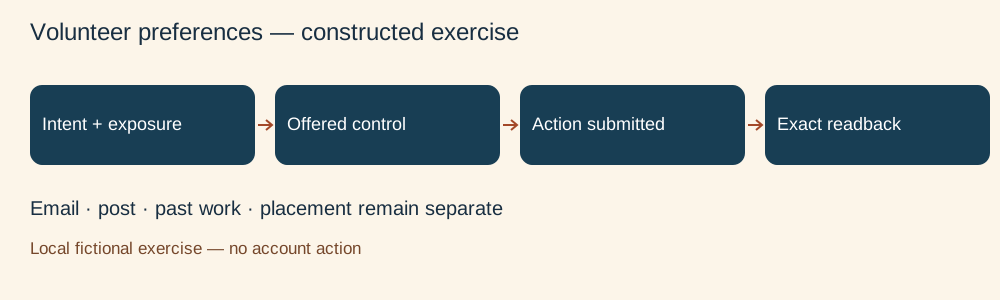
Record the intended revision before changing the preference. After an intentional save, reopen that exact member’s preference and compare the actual fields. A submitted Save or another member’s similar card is not that readback. Keep an unobserved result open rather than repeating account actions to force a receipt.
The 2024 launch described an optional post and global availability in English. Those are historical launch statements, not a current universal eligibility rule or a guarantee that your account offers the same prompt. A prepared announcement is still a draft. Current saved interest, an actually published post, notification delivery and a later volunteer agreement each need their own evidence.
Edit or remove the exact preference without erasing another history
The dedicated task edits an existing volunteer-preference box in the profile introduction and describes Save or Delete there. Confirm the object before choosing the action. Its removal wording concerns that preference; it is not an instruction to delete a genuine Volunteer experience or employment-history entry.
After a deliberate removal, inspect the current preference state. Turning matching emails off is not the documented removal action, and a submitted Delete does not prove later absence. Separate posts, screenshots, external copies and actual previous work remain different records. Do not promise recall or that every search or language presentation has already changed.
Resolve ten constructed preference and removal records
The local exercise uses fictional member P1, preference F1 and revision r2. C1, S1 and G1 stand for declared cause, offered documentation task and region; they are teaching references, not verified native menu labels. The intended arrangement is Remote and the email choice is off. These declarations do not authenticate a person’s skills, history or availability.
V1 supplies a submitted Save with no readback: keep completion unobserved. V2 requires recruiter-only confidentiality: hold the exposure requirement. V3 supplies the current preference still present with email off: retain presence and leave delivery unknown. V4 substitutes On-site and another region: hold the changed intention.
V5 supplies another member’s card and is held. V6 aims a removal at historical volunteer work instead of the preference and is held. V7 supplies the exact current preference plus a prepared post: record the bounded supplied state, not publication or a placement. V8 supplies no actual offered control; a draft and the historical launch do not fill that gap.
V9 supplies a submitted Delete without later readback; removal remains unobserved. V10 supplies absence of the exact preference, while past work and external copies stay unknown. All ten cases are declared teaching inputs. A hold is our planning safeguard, not an observed LinkedIn rejection or a privacy guarantee.
Run the bounded checks and keep a minimal private record
The packet includes ten actual CSV plans, independent facts and supplied observations, complete bilingual decisions, private blank records, two original text drafts and localized workflow diagrams. With existing Python 3, extract the ZIP and run python3 check.py; the optional rebuild uses only the standard library. The draft is a plain-text teaching example, not a sent message, application or published post.
Duplicate and cross-case references, unsupported delivery/publication/placement claims, changed intentions, stale revisions and wrong-member/object readbacks are rejected or held. The checker compares declared records; it does not certify their truth, arbitrary wording or account state. Current primary bodies were read separately in English and German on 2 November 2026. No private profile, People search, mailbox, volunteer application, setting or account action was used, and no reader or customer outcome was measured.
Sources & product references
Product details reflect the publication date. External features and interfaces may change.
- LinkedIn: current volunteer-preference task, English
- LinkedIn: current volunteer-preference task, German
- LinkedIn: separate profile sections, including volunteer experience
- LinkedIn: accurately labeled professional Experience
- LinkedIn: separate job-interest privacy and Recruiter scope
- LinkedIn: historical Open to Volunteer launch, 13 November 2024


