
The short answer
Define what you want to do on a specific input and what an inspectable output must contain. Match practice and review criteria to that task, then attempt a fresh case with the help conditions recorded. Keep time spent, course completion, practice output and actual performance evidence separate. A successful narrow exercise supports that task under those conditions, not a general credential or business result.
What you’ll take away
- Choose an action and output instead of an undefined aim to become an expert.
- Review the same criteria before and after feedback, preserving the original attempt.
- Use a fresh case and disclose help; rehearsing an answer is not broad competence proof.
Choose a small professional task and its output
For a creator who writes analytics explanations, a useful objective is: produce a short note that preserves the reported unit, observation window, supported arithmetic and unknown quantities. “Learn analytics” does not specify what a reviewer can inspect. State the input, output, allowed references and a realistic next review point. Start with an owned or permitted exercise rather than private client data.
CMU’s course-design guidance aligns objectives, assessments and instruction and uses observable actions to clarify vague goals. We apply that general principle to our own professional practice task. It is an educational framework, not evidence that this packet teaches every reader successfully or establishes an accredited assessment.
Declare criteria and help before the attempt
Use four explicit criteria: correct unit, correct date/window, warranted arithmetic, and an honest statement of what remains unknown. Keep critical factual errors visible rather than hide one behind a high average. Record whether the exercise permits notes, a calculator, worked examples, another person or software assistance. Independent recall and a useful assisted work product answer different questions.
A course completion or endorsement count can be recorded separately without becoming the task result. The learner should produce something inspectable: an actual written note and its source reference. Our sample attempt and review are authored fixtures; no person completed this exercise and no automated script can judge the quality of arbitrary new explanations.
| Criterion | What to inspect | Not enough |
|---|---|---|
| Unit | What the number counts | A number without its meaning |
| Window | Snapshot date or measured period | An undated “this year” |
| Arithmetic | Only operations supported by supplied inputs | A plausible result from a guessed denominator |
| Unknowns | Missing information and limits remain explicit | A completion badge or confident wording |
Review a complete practice note against its source
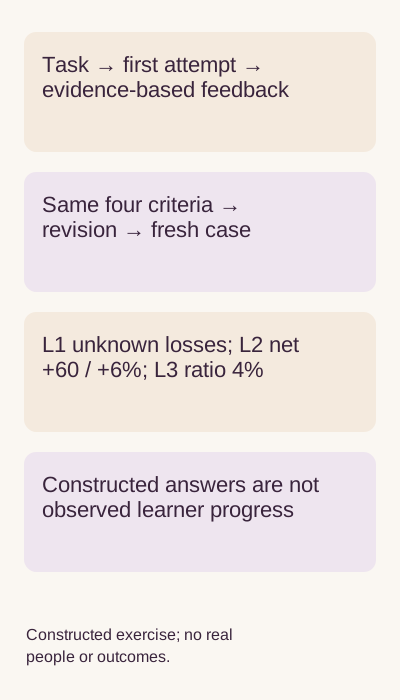
Constructed input L1: a snapshot shows 1,200 followers on 31 October; the same account reports 90 new follows during October, but unfollows are unknown. Incomplete sample: “On 31 October the account has 1,200 followers and 90 October follows, so net growth is 90.” Unit and dates appear, but the final inference is unsupported. Missing losses prevent a net-growth or starting-stock claim.
Revised sample: “The 31 October snapshot is 1,200 followers. October has 90 recorded new follows. Unfollows are not supplied, so net growth and the starting follower stock are unestablished.” This fixes the particular inference while retaining the original attempt for comparison. A review of four stated criteria is not a percentage score for someone’s overall professional ability.
The complete inputs, original/revised notes and answer key are in the packet. Its checker verifies the authored fixture’s numerical boundaries and flags; it does not score a real learner, infer understanding from a download or certify that a similar report is correct.
Two hypothetical completions show the problem: with no other adjustments, different loss counts can produce the same observed ending stock and 90 gains. These are possible teaching histories, not estimates of the missing data or probabilities.
| Possible losses | Compatible start | Gains | Ending stock |
|---|---|---|---|
| 0 | 1,110 | 90 | 1,200 |
| 40 | 1,150 | 90 | 1,200 |
Try a fresh case with the same criteria
Constructed L2 changes what is known: starting stock 1,000, 90 gains, 30 losses and ending stock 1,060, with the fixture explicitly declaring complete same-account flows and no other adjustments. Here 1,000+90−30=1,060, net change is 60 and the baseline-relative change is 6%. The reasoning changes because the inputs changed, not because every follower report supports net growth.
Constructed L3 tests transfer to a different reporting unit: 80 reactions plus comments divided by 2,000 impressions gives 4%. It is an event-to-impression ratio, not the percentage of distinct people who responded. Write a new explanation before reading the answer key and record the assistance used. If a criterion still fails, target that component rather than simply repeat the polished sample.
Use feedback and a later attempt without inventing a learning effect
The IES practice guide concerns education and recommends spacing, alternating worked solutions with problem solving, and retrieval opportunities, with different evidence ratings for its recommendations. It does not validate this professional worksheet or prescribe one universally optimal interval. Choose a feasible later attempt for your actual work, preserve the conditions and inspect the same criteria.
Record source, attempt, feedback, revision and later-case result separately. Looking at a solution can be useful practice, but do not label the subsequent copy an unaided assessment. If you later show the work on LinkedIn, describe the concrete exercise and actual help; do not convert it into independent certification, a client implementation or proof that a course caused a career outcome.
Keep a learning record that supports a narrow claim
The editable record includes objective, permitted input, output, four criteria, help conditions, original attempt, review, revision and a fresh-case plan. The original packet adds three full prompts, a separate bilingual answer key and an incomplete/corrected note. Open only the minimum material needed for your exercise and keep any real private work appropriately protected.
Primary educational guidance was read on 1 November 2026. All L-inputs and sample attempts are invented teaching material, not student or customer observations. The local checker establishes arithmetic and stated fixture conditions only. No course was bought, person assessed, credential awarded, profile changed or reader learning gain measured.
- Define one observable task and output.
- Set criteria and allowed help.
- Produce and retain the initial attempt.
- Review, explain errors and revise.
- Try a fresh case later and make only the claim its evidence supports.
Sources & product references
Product details reflect the publication date. External features and interfaces may change.


