
The short answer
For an already intended, appropriate communication, check the actual member, relationship and offered message route before considering a credit. A connection message, a free Open Profile message and member InMail have different eligibility. Record the existing product and available capacity, then separate the chosen route, an actual send, credit movements and the recipient’s response. A returned credit can follow a decline; it does not establish interest, agreement or a customer.
What you’ll take away
- A Premium recipient’s Open Profile can offer a free route to a sender who is not connected.
- Credit expiry, monthly allotment and a response-based credit return use different events and clocks.
- A balance increase or missing read indicator cannot establish a positive reply.
Define the communication and the member you actually mean
Start with a specific existing professional purpose: for example, answering a collaborator’s agreed question about a public source. Confirm the intended member from reliable context and keep an uncertain identity unresolved. A name match or an available button does not establish a relationship, permission to quote or a reason to contact someone repeatedly. This review needs no prospect list or test recipient.
The workflow concerns ordinary LinkedIn member messaging and an entitlement you already have. Page inboxes, Sales Navigator, Recruiter and Hiring Pro have their own identities, credit pools and instructions. Member Premium credits cannot simply fund another product’s InMail. The related renewal guide reviews whether an existing subscription is useful; this guide completes the separate route and capacity decision without buying a plan or starting a trial.
Read the offered route before assuming it costs a credit
LinkedIn’s overview describes InMail as a Premium feature for nonconnections. Its specific sending help also states the Open Profile exception. A Premium member who enables Open Profile can be contacted free by other LinkedIn members outside their network. Enabling that recipient feature and being the sender are different roles. Do not turn the overview into a rule that every nonconnection message requires the sender to subscribe.
For member InMail, the documented desktop profile route uses More and Message; mobile uses Message. The Open Profile help describes Message on desktop and InMail on mobile. A button’s word alone therefore does not prove a fee. Inspect the actual offering, intended recipient and existing account state before any intentional Send. Open Profile messaging still has limits; free does not mean unlimited or guaranteed available.
| Observed situation | Route to inspect | State that remains separate |
|---|---|---|
| Verified first-degree connection | Ordinary member message | A connection does not establish agreement to the request |
| Nonconnection with an offered Open Profile route | Free Open Profile message | Recipient feature and current availability need their own evidence |
| Eligible nonconnection and existing member InMail capacity | Credit-bearing member InMail | Capacity is not a send, a response or permission to repeat |
| Recipient refusal, unanswered prior InMail or unresolved offering | Hold the affected route and inspect the documented boundary | Do not manufacture capacity or a second contact to test it |
Keep product, balance and the two 90-day questions explicit
The current member help points to My Premium for the current balance, renewal date and monthly allotment. Read those fields for the actual product instead of copying a universal allowance. Member allotment follows its billing cycle; the same help names a different renewal convention for Sales Navigator. A mixed-product FAQ also mentions unlocking a lead and Hiring Pro. Those statements do not make every ordinary member profile a lead that must be unlocked.
The FAQ describes credit expiry after 90 days. The crediting help separately describes a qualifying acceptance, decline or direct response within 90 days of sending; quick replies count, while pending is not accepted or declined. Credit age and time since a message was sent are different clocks. A credit returned after a negative response restores declared capacity without demonstrating positive interest. The source also says another InMail cannot be sent to that member until the first is answered.
Preserve the actual account, dates and observed confirmation when reconciling a real balance. Expiry, a new allotment, a credit return and product changes can affect capacity differently. A cancellation or upgrade review needs its own current terms and readback; unused credits are not a promise of future access or a cash refund.
Reconcile the complete constructed six-event ledger
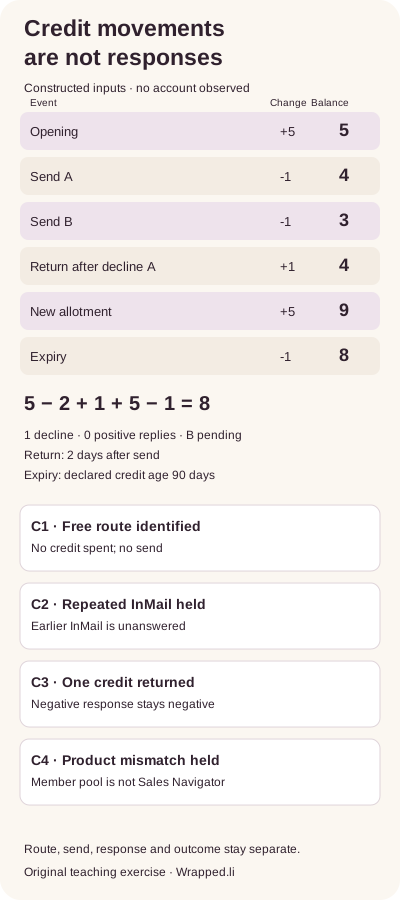
Our supplied fictional ledger opens with five units, records two sends, one returned credit after a declared decline, five newly allotted units and one expired unit. The consecutive balances are 5, 4, 3, 4, 9 and 8: 5 − 2 + 1 + 5 − 1 = 8. These chosen teaching values are not a plan allowance or an observation from a real account. The return points to message A; message B remains pending.
There is one explicitly negative response and no positive response in these inputs. The balance rising from five to eight cannot be reported as three replies or three new interested contacts. The checker preserves event order and units, connects the returned credit to its supplied response and rejects duplicate event IDs or a declared closing balance that does not match the movements. Rebuilding the packet checks these constructed records, not LinkedIn billing.
Resolve four route decisions without a test send
C1 gives a fictional Basic sender an explicitly offered free Open Profile route. Decision: record that route without spending an InMail unit or inferring a new subscription requirement. Outcome: a route identified for a separate deliberate communication decision, not a sent message. C2 gives an existing member Premium balance but an unanswered earlier InMail to the same member. Decision: hold the repeated InMail despite the positive balance; do not switch products or accounts to bypass the unresolved boundary.
C3 supplies the negative reply and returned credit from message A. Decision: reconcile the one returned unit and retain the negative response. Outcome: capacity and reply polarity remain different facts; no interest or customer is counted. C4 proposes using member Premium capacity in Sales Navigator. Decision: hold that product mismatch and use the correct product’s own evidence if a legitimate task remains. The fictional member balance is not proof of capacity elsewhere.
Leave a missing or unverified offering and an uncertain action outcome unresolved; respect an explicit recipient refusal. If an actual authorized send has already happened, inspect its existing record before any retry. LinkedIn’s indicator help excludes read receipts and typing indicators for InMail senders; their absence does not prove the message was unread or justify repeating it.
Save the bounded decision and reconcile the source discrepancy
The current English sending help and German FAQ support an optional subject up to 200 characters and body up to 2000. The German sending page currently says a two-character body. That observed source discrepancy is not a usable two-character rule. Keep the conflicting source beside the corroborating versions and inspect any actual composer counter when available. This guide does not claim a native character-count test or a universal emoji-counting rule.
The private record joins purpose, intended member reference, relationship, actual product, offered route, existing balance, relevant dates, unresolved prior InMail and separately observed send/response state. The packet includes complete English/German cases, a blank record, actual CSV inputs, results, diagrams and a standard-library rebuild. Current primary bodies were checked in both languages on 1 November 2026. All examples are constructed; no person was contacted, account changed or paid feature tested. They establish neither reader preference nor business value.
Sources & product references
Product details reflect the publication date. External features and interfaces may change.
- LinkedIn: member InMail scope, English
- LinkedIn: InMail-Umfang, Deutsch
- LinkedIn: sending routes and Open Profile exception, English
- LinkedIn: Sendewege und Open-Profile-Ausnahme, Deutsch
- LinkedIn: credit renewal and qualifying responses, English
- LinkedIn: Guthaben und anrechenbare Antworten, Deutsch
- LinkedIn: InMail FAQ and credit expiry, English
- LinkedIn: InMail-FAQ und Guthabenablauf, Deutsch
- LinkedIn: Open Profile recipient and sender roles, English
- LinkedIn: Open-Profile-Empfänger und Absender, Deutsch
- LinkedIn: Open Profile route and limits, English
- LinkedIn: Open-Profile-Weg und Grenzen, Deutsch
- LinkedIn: InMail read/typing indicator exception, English
- LinkedIn: InMail-Ausnahme für Lese-/Eingabeanzeigen, Deutsch
- Original route and credit exercises with complete bilingual records


