
The short answer
Start with the intended Page, actual super-admin authority and evidence about the precise current employment statement. For a verified Page, current help documents the member-profile More action Never an employee of my org, followed by the organization choice and Submit. Use that wording only when it is true. The nonverified-Page form is a different route with its own required information. A report receipt, the member’s verification or challenge period, disassociation and a later displayed count are separate states; none proves deletion of a whole profile.
What you’ll take away
- A profile association does not grant Page-admin authority or prove a real employment relationship.
- Check the truthful statement and actual route before any report.
- Submission, conditional disassociation and delayed counts need separate readback.
Name the exact Page, member and disputed statement
LinkedIn’s associated-member help says people can select an organization in their profile Experience and appear on that organization’s Page. A mistaken organization selection can therefore produce a wrong association. The public name alone does not establish that two organizations or two people are the same. Retain the exact intended Page and information privately rather than making a list of suspected employees for a public post.
This task concerns a specific inaccurate association, not reducing a Page total, removing an admin, changing a member’s own Experience or deleting a whole profile. Associated-member counts are not a verified workforce census. A missing verification badge, unfamiliar name, absent response or disagreement with someone is not evidence that their employment statement is false. If the factual basis is missing, hold the report.
Keep the literal claim supported by what you know
Write down the exact current statement you believe is wrong and the permitted basis for that belief. A real former employee with an outdated current-role label is different from someone who was never employed by the organization. Do not select Never an employee merely to tidy an old date or make the count smaller. That hold is our factual planning safeguard, not a claim that the interface rejects every such selection.
Our teaching records use neutral references and supplied fictional facts; they cannot investigate a real person or certify employment truth. One case deliberately supplies a genuine former relationship and an unsupported never-employed claim. Another leaves the evidence unresolved. Both stop before an intentional report. Keep any actual employment evidence, identity details and signature out of shared example records.
Use the specific current task instead of an old route
The broad association overview refers to admins, but the dedicated reporting tasks require super admins. Content admins, paid-media admins and analysts do not acquire this reporting permission from their other tasks. Confirm authority for the intended organization and the Page’s actual verification state. A member’s profile badge is not the organization Page’s verification status, and public association with a company is not admin access.
Older help text refers super admins to support and says admins cannot directly remove associated members. The current dedicated English and German tasks describe the verified-Page report and the separate form route below. Reporting with a conditional later disassociation is different from directly editing another member’s profile. Use the current specific task for the actual offered state. An unavailable old help address or a cached translation does not establish that the feature has been retired.
For a verified Page, inspect the offered current-employment report
The current dedicated task says the organization Page should be verified. From the intended member profile, its desktop or mobile instructions use More, Never an employee of my org, the prompted organization choice and Submit. Match the organization in that choice; a correct role on one Page does not authorize a report for another similarly named Page. If the truthful applicable action is not offered, keep that route unresolved rather than borrowing Recruiter or another product’s controls.
The task says reporting the current employment information this way is anonymous: the member is not told which admin made the report. It then gives the member seven days to verify their work email and describes disassociation if they do not. This is a conditional workflow, not immediate erasure or proof of a false identity. Do not extend that anonymity statement to every form, every provider record or a public allegation.
- Confirm the exact organization Page, super-admin access and actual verified state.
- Check the precise current employment statement and the truth of the proposed action.
- Inspect the documented action on the intended member and choose the correct organization.
- Review the final prompt before a separate deliberate submission.
- Retain an actual receipt or uncertain state and inspect the later association without speculative repetition.
For a nonverified Page, keep the form and its evidence separate
The current inaccurate-information help gives super admins of nonverified Pages a form route for inaccurate employment or education associated with their Page. The specific verified-Page task also links a form when the Page is not eligible for verification. The help requests a link to the information, the disputed Experience or Education, an explanation of how you know it is inaccurate and a digital signature. A content-admin submission is not made eligible by filling those fields.
Our plain-text examples are explicitly fictional, unsigned drafts with a .invalid reference. They are not the native form, a digital signature or a submitted claim. A prepared evidence note and an actual submitted receipt remain different records. Do not collect more personal data just to complete a teaching sheet. The help limits its review to employment/education and provides a separate route to challenge a mistaken report.
Keep the three clocks and a possible challenge distinct
The verified-Page task describes seven days for work-email verification. The form help describes removal of reported information within fourteen days unless the member challenges it. The association overview separately allows up to thirty days for displayed counts to update after additions or removals. These are different processes, not interchangeable wait periods or a timer that proves what happened to a particular profile.
The package records a declared three-day report with an unchanged displayed count of 102, a supplied form challenge and exact seven-/fourteen-day boundary cases. The boundary cases remain untested planning holds, with actual outcomes unknown. UTC subtraction in fictional inputs does not establish LinkedIn’s precise deadline calculation. A missing clock, pending verification, challenge or absent readback stays explicit; elapsed time alone never becomes an observed removal.
| Supplied state | Bounded conclusion | Not established |
|---|---|---|
| Verified route offered; no receipt | Prepared for a separate report step | Report sent or member removed |
| Form draft with required-review placeholders | A fictional unsigned plan | Valid signature or submitted report |
| Receipt; count still 102 after three declared days | Receipt and count observation | Failure, workforce size or reason to repeat |
| Matching supplied disassociation | That association state only | Whole-profile deletion or admin revocation |
Read back the same association before another action
Keep the intended Page/member, exact disputed revision, actual action time and any confirmation or error together. A timeout after Submit leaves the submission uncertain. Inspect the available current state before repeating a report. A received request is not an approved conclusion, and a member’s challenge is not an automatic rejection of their own history.
If disassociation is later actually observable, describe that specific result. Check any remaining profile wording, Page admin access, followers, external copies or displayed total separately when relevant. Our supplied disassociation case leaves those other scopes unchanged; it does not test the real platform’s side effects. Neither a changed number nor a new screenshot demonstrates that every copied statement or earlier notification disappeared.
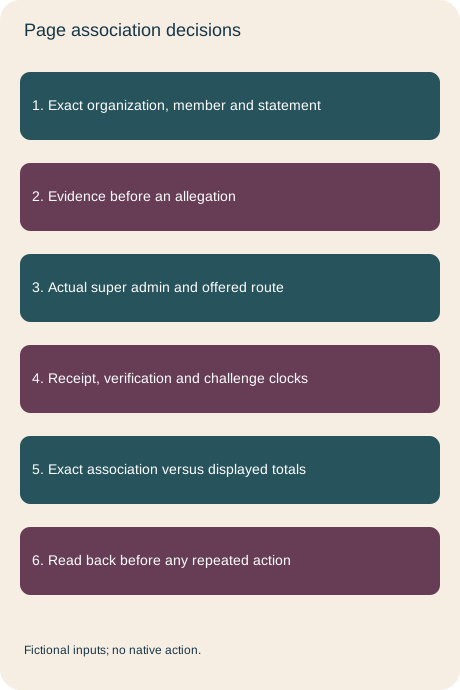
Use twelve decisions and a private record before the real step
The original packet executes twelve association cases and six separate Page-task/role cases. It retains independent fictional facts, CSV plans, supplied observations, full bilingual decisions, private blanks, unsigned text examples and four localized diagrams. With existing Python3, run python3 check.py or rebuild with python3 build.py --output NEW_FOLDER. The extracted standard-library rebuild reproduces all package files byte for byte. It installs nothing and contacts no account or service.
The checker enforces declared identities, versions, role scopes and supplied observation boundaries. It does not verify actual employment, signatures, permission, native eligibility or the meaning of a new allegation. Current official English and German bodies were revalidated on 2 November 2026. No private profile, employee list, real evidence, signature, report, form, support request or account action was used. The intended finish here is a defensible review record, including a valid decision to hold.
Sources & product references
Product details reflect the publication date. External features and interfaces may change.
- LinkedIn: Page association, current reporting and role scope (a542848, en)
- LinkedIn: Page association, current reporting and role scope (a542848, de)
- LinkedIn: Page association, current reporting and role scope (a1337291, en)
- LinkedIn: Page association, current reporting and role scope (a1337291, de)
- LinkedIn: Page association, current reporting and role scope (a16542031, en)
- LinkedIn: Page association, current reporting and role scope (a16542031, de)
- LinkedIn: Page association, current reporting and role scope (a541981, en)
- LinkedIn: Page association, current reporting and role scope (a541981, de)
- LinkedIn: Page association, current reporting and role scope (a550647, en)
- LinkedIn: Page association, current reporting and role scope (a550647, de)
- Original fictional association and Page-role decisions


